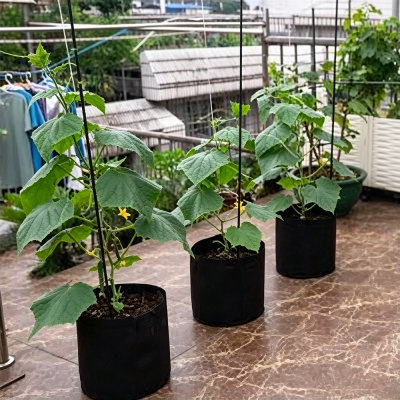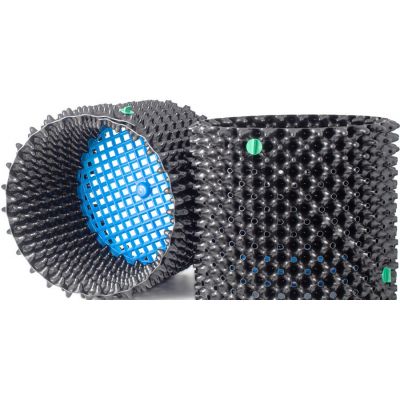


Three gallons is where most orders land, and it is worth understanding why. The size is large enough to carry a shrub or a young tree through its first full season without potting on, and small enough that a block of them can still be lifted and moved by hand rather than by machine. It suits palms, patio trees, large houseplants and nursery stock that will be sold within a year. Across the range the same wall runs from 2 to 45 gallons, so a nursery can order the whole ladder in one specification and one colour rather than mixing containers from different suppliers.
Ask a nursery which container size it buys most of and the answer is usually a mid-range figure rather than the largest one. The reason is practical: below a certain volume the plant has to be potted on before it is saleable, and above it the pot can no longer be moved by hand. The size in the middle carries a plant for a full season without either problem.
A three gallon container holds a shrub or a young tree through a whole growing season without the plant running out of root room, and it stays light enough that a block can still be shifted by hand rather than waiting for a machine. That combination covers a lot of ground: patio trees, palms, large houseplants, and nursery stock held for one season before sale. Because the container is the same wall as the larger sizes, moving a plant up to a bigger pot later is a repot rather than a change of system, and the roots are already trained the same way. The same range logic applies across the whole root control container range, and for growers working across several crops it sits alongside the shade net and planting bag ranges.
The wall is supplied in diameters from 15 cm to 200 cm and heights from 15 cm to 60 cm, which covers the range from about 2 gallons to about 45. The useful way to pick a size is to start from the root ball the plant will have when it is sold, not from the volume it is in now, because a container that is oversized for the plant leaves a band of wet medium around the roots that does not dry out between waterings. From there the base disc is matched to the diameter, and the height is set by how deep the roots are expected to run. Because panels are supplied flat, one shipment can cover several sizes on the same pallet.
| Model | RC-006 |
| Material | Plastic |
| Volume Range | 2 gallon to 45 gallon |
| Diameter | 15 cm to 200 cm |
| Height | 15 cm to 60 cm |
| Shape | Round |
| Colour | Black, grey, blue or as required |
| Packing | PP bag or carton, palletised for export |
The mid sizes suit plants that are grown for their root structure as much as their top growth. Bonsai and trained stock benefit because the fibrous root mass that forms is easier to work with at repotting than a coiled one, and the roots can be lifted and combed without the tangling that comes out of a smooth pot. Patio trees and large houseplants benefit for a simpler reason: the pot drains and vents, so a plant standing indoors over winter is less likely to sit in a saturated medium, which is the commonest cause of root loss in an over-watered indoor plant. Floor standing containers at this size also suit greenhouses and covered growing areas where benches are not used.
Standard colour is black, with grey and blue available and custom colours matched on request. Minimum order is 500 pieces with an FOB range of USD 1.2 to 1.6 per piece, samples are available, and delivery runs about 15 days after deposit with L/C and T/T accepted. Because the container is ordered by the piece at this size and by area at larger diameters, it is worth fixing the root ball diameter first and letting the volume follow. Trade coverage of how nurseries manage container stock, such as HortiDaily and FreshPlaza, is worth following if you are specifying for more than one crop.
What can I grow in a 3 gallon air pruning pot?
A shrub, a patio tree, a palm or a large houseplant for a full season without potting on, and nursery stock that will be sold within the year.
How do I choose between 2 and 45 gallon?
Start from the root ball the plant will have at sale rather than its volume now. An oversized container leaves wet medium around the roots that does not dry between waterings.
Can the pots be reused?
Yes. They are supplied with a separate base disc, so the wall can be cleaned and re-formed the following season. Tell us the crop and the holding period and we will confirm the size.
Tell us the plant you are growing, the root ball diameter at sale and the quantity, and we will confirm the size, the colour and the packing that suit your order.
Mark Wu, Co-founder & Technical Director, Sichuan Zhifang Net Industry. 15 years manufacturing agricultural nettings and nursery containers for growers in 32 countries.