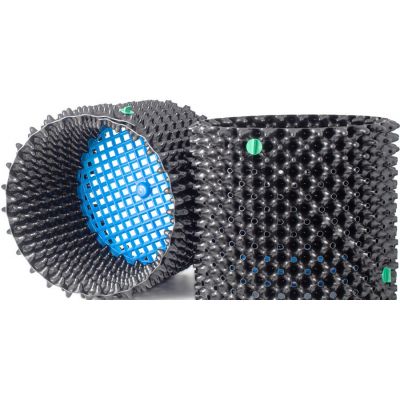


Two costs dominate a nursery season and neither appears on the container invoice: the water that gets carried to the benches, and the handling that goes with re-potting or root pruning before sale. A pot with open cones changes both. Because the wall drains and vents at every cone, water that would otherwise sit at the base passes through, which removes the commonest cause of root rot in an over-watered block. And because the roots are pruned by air rather than coiled against a smooth wall, plants can be lifted and sold without a root-pruning step. Sizes run from 2 to 45 gallons, with diameters of 15 to 200 cm.
A nursery buys pots by the hundred and pays for labour by the hour, and the second number is usually the larger one. Watering rounds, re-potting, and the root pruning that happens before a plant leaves the nursery all scale with how the container behaves, not with how much it cost per piece. That is the case for an air pruning pot that is worth checking before the price comparison.
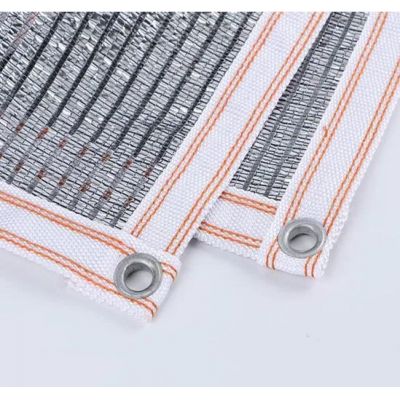
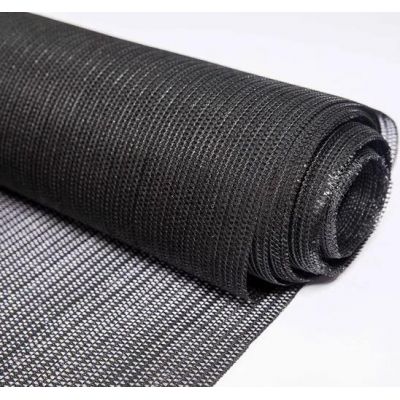
An open-walled container drains at the sides as well as the base, so a block that is watered generously does not hold a saturated layer at the bottom of every pot. That matters on a bench where plants are close together and air movement is limited, because it is the wet base, not the wet surface, that starts root rot. The same openings vent the root zone, which keeps the medium from staying waterlogged after a heavy irrigation run. The second saving is at the other end of the season: roots trained by air do not need to be teased or cut before the plant is sold or planted out, so the handling step disappears. The same logic runs through the whole root control container range, and for growers working across several crops it sits alongside the shade net and planting bag ranges.
It is worth being precise about this, because the saving is real but it is not free. The pot still has to be filled, set out and lifted like any other. What changes is the number of interventions per plant: fewer rescue waterings after a hot day, less culling for rotted roots, and no root-pruning bench at dispatch. On a block of a few thousand plants those three add up to days of work rather than hours, which is why the calculation is normally done over a season rather than per pot. A plant that keeps its whole root system also establishes faster after planting, so the first field season is spent growing rather than recovering.
| Model | RC-001 |
| Material | PVC |
| Diameter | 15 cm to 200 cm |
| Height | 15 cm to 60 cm |
| Volume | 2 gallon to 45 gallon |
| Shape | Round |
| Colour | Black, grey, blue or as required |
| Packing | PP bag or carton, palletised for export |
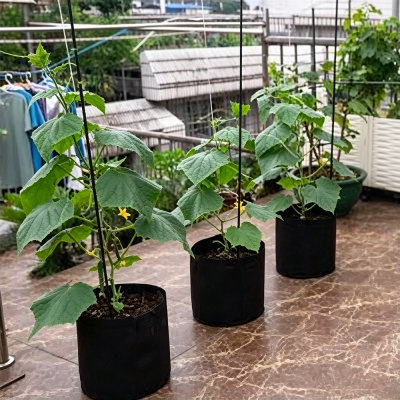
The container is a floor-standing type and will also sit on a bench at the smaller sizes. Used outdoors it can be set directly on gravel or a membrane, because the base drains and does not rely on a raised tray, which suits tree stock standing out through a season. Indoors or under cover, the same pot works on a greenhouse floor for vegetable and flower propagation. Heights of 15 cm to 60 cm and diameters of 15 cm to 200 cm mean the same container family covers a seedling and a specimen tree, so a nursery can standardise on one wall thickness and one base disc across its whole range.
Standard colour is black, with grey and blue available and custom colours on request. Custom logos are accepted, which is useful where the container is sold on to a garden centre under its own name. Minimum order is 500 pieces with an FOB range of USD 1.2 to 1.6 per piece, samples are available at USD 10 per piece, and delivery runs about 15 days after deposit with L/C and T/T accepted. Trade coverage of how nurseries handle irrigation and container stock, such as HortiDaily and FreshPlaza, is worth following if you are specifying for more than one crop.
Does an open-walled pot really reduce watering work?
It reduces the corrective work rather than the routine work. The pot still needs watering on schedule, but there is less risk of a saturated base after a heavy run, which is what usually triggers emergency attention.
Do I still need to root prune before sale?
No. Roots trained by air are already fibrous and distributed, so plants can be lifted and dispatched without a root-pruning step.
Can the pots stand outside through a season?
Yes. The base drains on its own, so the container can be set on gravel or a membrane outdoors without a raised tray. Tell us the crop and the standing period and we will confirm the wall thickness.
Tell us the pot volume or the root ball diameter, the quantity and any colour or logo requirement, and we will confirm the size, the thickness and the packing that suit your order.
Mark Wu, Co-founder & Technical Director, Sichuan Zhifang Net Industry. 15 years manufacturing agricultural nettings and nursery containers for growers in 32 countries.