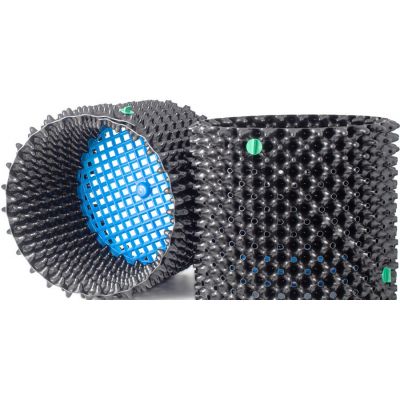


A moulded pot fixes the size and the shape at the factory, so a grower who wants a different diameter buys a different pot. A panelled root control system works the other way: the wall is a strip that is cut to the diameter needed and clipped or bolted to a base, so the same components cover a round, a square or a rectangular container and the diameter changes with the wall length. That matters when the crop is a tree that will be in the container for years and will outgrow every size the moulds come in. The wall itself carries the air pruning: the raised nodes and openings stop the root tips that reach them.
Root control works the same way in a plastic container as it does in a fabric bag, but the container itself is built differently, and it is worth understanding what that changes before specifying a size that has to last several years.
A moulded pot is one piece of tooling per size, which is why the range of sizes is limited to what the moulds cover and the price rises sharply for anything unusual. A panelled system is a wall strip and a base, and the wall is cut to the length that gives the diameter needed. The same components then cover a round container, a square one or a rectangle, because the shape is decided by how the wall is bent rather than by a mould. For a tree that will be in the container for several seasons that is the useful property, since the same order can be assembled at one diameter now and reassembled at a larger one later by adding wall. The base plate sets the floor and the drainage.
The containers are used in greenhouses and polytunnels where trees and shrubs are grown on, in tree nurseries holding stock for several seasons, and in field planting where a root control ring is installed around a tree to stop the roots spreading into a paved or drainage area. Because the plastic is rigid rather than fabric, the container holds its shape when it is lifted and it does not dry out through the wall the way a fabric bag does, which suits a house where water is being managed closely. The raised nodes inside stop the root tips that reach them, so the roots branch back into the medium. Growers ordering containers for the same programme often add a planting bag for the stages where a fabric pot is wanted, and where the house also needs shade, the shade net range covers that separately.
| Model | ZF-AP023 |
| Function | Air pruning and root control |
| Wall thickness | 0.6 mm, 0.7 mm or 0.8 mm, customised |
| Shape | Round, square or rectangular, assembled from panels |
| Use | Indoor and outdoor planting, root control, fast growing |
| Reuse | Durable and reusable, easy to assemble and strip down |
| Packing | Bag, pallet or carton; panels stack flat |
| Sample | Free sample available |
The three wall thicknesses are not cosmetic. A thinner wall bends more easily, which makes a small diameter quick to assemble, and it is the right choice for a crop that will be in the container for one or two seasons. A thicker wall resists bulging under the pressure of wet medium, which becomes the deciding factor as the diameter grows: a large container carries a load that will push a thin wall out of shape, and a wall that has bulged stops sitting correctly against the base. For anything that has to hold a tree for several seasons, or that will be lifted and moved, the thicker grades are the ones worth pricing. The wall is also what does the work, because the raised nodes and openings are formed into it rather than added. Where a fabric container suits the crop instead, a grow bag with air pruning seams is also available in the same range.
The system is made to order by diameter and shape, with wall thickness selected from the three grades, and the same components cover round, square and rectangular assemblies. Colour and dimensions are set with the order, and a free sample is available so the wall and the base can be checked before a bulk run. Panels stack flat, which keeps freight and storage down compared with an equivalent number of rigid pots. Tell us the crop, the diameter, the expected time in the container and the quantity, and we will confirm the specification. Buyers tracking what is going into tree nurseries and greenhouse production can follow trade coverage such as HortiDaily and FreshPlaza for what growers are installing.
Which wall thickness should I order?
Thinner walls for small diameters and short crops, thicker walls where the container is large or the tree stays in it for several seasons, because a thin wall bulges under wet medium. Tell us the diameter and the term.
Can the same parts be reassembled at a larger size?
The wall is cut to length, so the assembly can be changed by altering the wall rather than buying a new moulded pot. That is the main advantage of a panelled system on a long term crop.
Does it work for field planting as well as containers?
Yes, it is used both as a container and as a root control ring installed around a tree in the ground, which is what keeps roots out of paved and drainage areas.
Tell us the crop, the diameter, the expected time in the container and the quantity, and we will confirm the specification, the sample and the packing that suit your order.
Mark Wu, Co-founder & Technical Director, Sichuan Zhifang Net Industry. 15 years manufacturing agricultural nettings for growers in 32 countries.