

Above a certain diameter a container stops being something a person carries and becomes something a block is planned around. That change is worth designing for, because the handling that suits a bench does not suit a row. A large container is heavy when full, so it is lifted with a machine or dragged along a membrane rather than picked up, and the base has to take that. Spacing has to allow for the root ball the plant will reach, not the one it starts with, or roots from neighbouring containers graft across the gap.
A nursery changes its handling the day a container gets too big to lift by hand, and it changes it silently: the bench layout, the trolley, the irrigation run and the lifting gear all shift at once. Planning for that transition is easier than discovering it after the first order arrives.
Up to about 30 cm the container is a bench item and the working assumptions are a person and a trolley. Beyond that it becomes a floor item, and the questions change. How is it moved without cracking the wall? How much space does each plant need so the roots do not cross into the neighbouring container? How is the irrigation run laid out so every pot fills evenly? These are the same questions a field grower asks, and the answers are why large diameter containers are usually set out in rows on a membrane rather than packed onto a bench. The same approach runs through the whole root control container range, and for growers working across several crops it sits alongside the shade net and planting bag ranges.
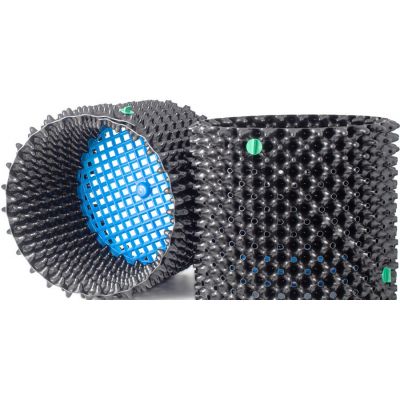
The spacing decision is usually made on the size the plant will reach by the end of the cycle, not the size it is now. Containers set close together to save floor space look efficient in month one and cause a problem in month six, when roots from adjacent pots meet through the openings and knit together. Because the wall is perforated, that graft happens more readily than it would through solid plastic, so the gap between pots is doing real work. Lifting follows the same logic: a full container of wet medium at the larger diameters is a machine job, and the wall is formed thick enough to take a sling or a fork without deforming, which is the practical reason thick walls are specified for large sizes rather than for small ones.
| Model | RC-014 |
| Material | Plastic |
| Diameter | 15 cm to 200 cm |
| Height | 15 cm to 60 cm |
| Shape | Round |
| Features | Detachable, heightened, high temperature resistant |
| Drainage | Good, perforated wall and base |
| Packing | PP bag or carton, palletised for export |
Large diameters are used for tree stock that will be sold as a specimen, for hedging plants held through more than one season, and for commercial fruit and ornamental production where plants stay in the container for a defined cycle. In all three cases the container has to do two things at once: hold a root system big enough to support the top growth, and train it so the plant can be lifted without a root pruning step. Bulk orders for commercial nurseries are normally taken as a mixed schedule, with one specification covering several diameters so the whole cycle uses the same wall, base and colour.
The wall is supplied detachable, formed from a panel rather than moulded as a solid body, which is what allows large diameters to ship flat and to be formed on site. Minimum order is 500 pieces with an FOB range of USD 1.2 to 1.6 per piece, samples are available, and delivery runs about 15 days after deposit with L/C and T/T accepted. Because the container is paid for by the piece at these sizes, it is worth converting the planting plan to a pot count before confirming. Trade coverage of how commercial nurseries manage large stock, such as HortiDaily and FreshPlaza, is worth following if you are specifying for more than one crop.
How close can large pots stand to each other?
Set the spacing on the size the plant will reach by the end of the cycle, not its current size. Roots can cross between perforated containers and knit together if they are packed too tightly.
How are large containers moved?
By machine or sling once they are full. The wall is formed thick enough to take a sling or a fork without deforming, which is why heavy walls are specified at larger diameters.
Do you supply a mixed schedule of sizes?
Yes. One specification covers the range from 15 cm to 200 cm, so a production cycle can be ordered with several diameters using the same wall, base and colour. Tell us the plan and we will confirm the mix.
Tell us the plant size at sale, the number of pots in the cycle and the spacing you plan to use, and we will confirm the diameters, the wall thickness and the packing that suit your order.
Mark Wu, Co-founder & Technical Director, Sichuan Zhifang Net Industry. 15 years manufacturing agricultural nettings and nursery containers for growers in 32 countries.