

Opening a bale is the part of the job that nobody photographs, but it is where a weak net shows itself. A roll made from new virgin HDPE in a warp knitted mesh cuts cleanly and lifts off in one piece, instead of tearing into strips that have to be picked out of the feed. Tension is what keeps the wrap tight through storage: 35 to 43 N at 8.33 gsm for hay and 43 to 55 N at 10 gsm for silage and dense straw. UV stability is in the yarn, so bales left in the open hold until they are needed. Widths run 1 m to 1.7 m, lengths 2000 m to 3000 m.
Everyone looks at how a net goes on. The part that decides whether a farm orders it again is how it comes off. A net that tears into strips at feed out adds minutes to every bale and leaves fragments in the feed, and that is the difference a roll made from new virgin HDPE is actually being paid for.
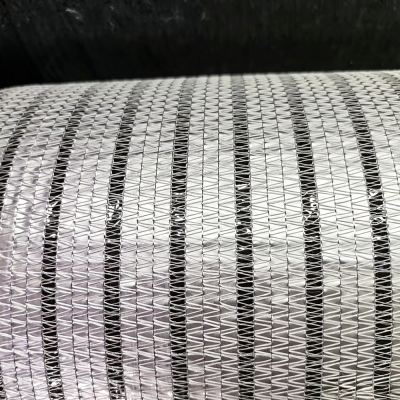
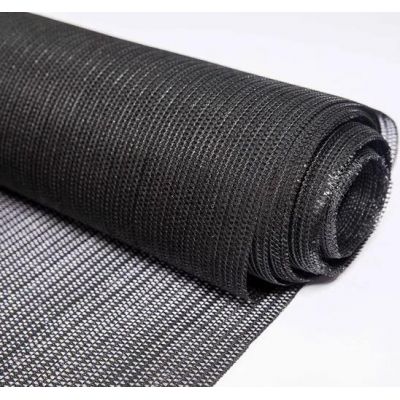
On a round bale the net is cut across the wrap and lifted away, and on a well made roll it comes off as one continuous sheet rather than breaking into pieces. That happens because the warp knitted mesh is a single interlocked structure: a cut edge does not unravel and a tear does not run. The open mesh also means the net is not bonded to the bale surface, so it lifts rather than pulling fibre with it. The 8.33 gsm roll at 35 to 43 N is enough for hay, and the 10 gsm roll at 43 to 55 N is the one for silage and dense straw, where the bale is heavier and the wrap is under more load.
New virgin HDPE gives the yarn a consistent thickness along its whole length, and that consistency is what makes the mesh behave the same at the end of a roll as it did at the start. Recycled blends vary from batch to batch, which shows up as weak points where the net tears early and leaves strip residue on the bale. The knitted structure also holds its width across the full length, so the wrap stays evenly pressed against the bale and there is no slack section to snag on the knife. For farms running the bale net wrap range alongside the shade net and planting bag ranges, the same material logic applies.
| Material | 100% new virgin HDPE, warp knitted |
| Weight | 8.33 g/m2 or 10 g/m2 |
| Tension | 8.33 g: 35-43 N | 10 g: 43-55 N |
| Net Width | 1 m, 1.22 m, 1.23 m, 1.62 m, 1.7 m or by requirement |
| Roll Length | 2000 m, 2134 m, 2500 m, 3000 m or by requirement |
| Colour | White |
| Removal | Cuts cleanly, lifts off as one sheet |
| Packing | Rolls on cardboard tubes, 16 or 12 rolls per pallet |
The same net runs on round and square balers; what changes is the width and length the machine is set for. North American balers commonly take 48 or 51 inch rolls in 9840 feet or 64 and 67 inch rolls in 7000 and 8000 feet, while metric machines take 1.22 m or 1.23 m by 3000 m and 1.62 m or 1.7 m by 2134 m. Those are the same rolls measured two ways, so it is worth agreeing on one convention before the order is placed. On removal, cutting along the wrap rather than across the end lets the net come away in one piece, and because the mesh is not bonded to the bale the residue left in the feed is minimal. Delivery runs about 15 days after deposit, with T/T and L/C both accepted.
Rolls ship on cardboard tubes, 16 or 12 to a pallet, giving 190 to 210 rolls in a 20 ft container and 490 to 510 in a 40 HQ. Minimum order is 2 tons, delivery is about 15 days after deposit, and capacity runs at 400 tons a month, so orders for a season can be scheduled ahead. For costing, work from bale count: at two to three turns per bale, a 3000 m roll gives a predictable number of bales once the diameter is fixed. Trade coverage of how growers open and handle bales, such as HortiDaily and FreshPlaza, is worth following if you are specifying for a mixed farm.
Does the net come off in one piece at feed out?
Yes. The warp knitted mesh does not unravel at a cut edge and does not tear along the bale, so the wrap lifts away as one sheet rather than breaking into strips. That is the main practical difference between new virgin HDPE yarn and a recycled blend with weak points.
Is the net biodegradable?
No, and we do not claim it is. The net is HDPE, which is chosen precisely because it does not break down while the bale is in storage. It is removed at feed out and can be collected for plastics recycling alongside other farm film.
Which weight should I order for round bales?
Round bales of dry hay suit the 8.33 gsm roll at 35 to 43 N. Dense silage and heavy straw bales suit the 10 gsm roll at 43 to 55 N. Tell us the baler width and the crop and we will confirm the weight and the roll length.
Tell us the baler type, the roll width your machine takes and how the bales are stored, and we will confirm the weight, the roll and the packing that suit your order.
Mark Wu, Co-founder & Technical Director, Sichuan Zhifang Net Industry. 15 years manufacturing agricultural nettings for growers in 32 countries.