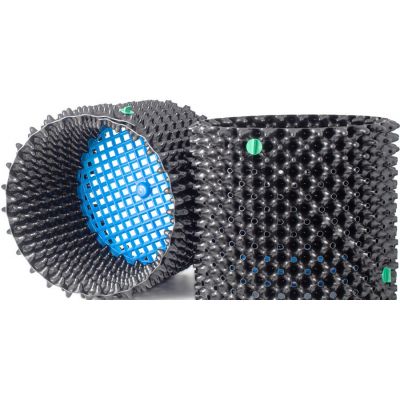


Bonsai and hydroponic growing make the same demand of a container, which is that the root system has to be workable rather than merely contained. In bonsai the roots are lifted, combed and cut back at every repot, and a root ball that has coiled against a smooth wall is slow to untangle and easy to damage. In hydroponic media the roots sit in a substrate that is flushed regularly, so the container has to drain freely at every point rather than only at the base. A perforated wall with an independent base answers both: the roots branch instead of circling, and the medium never holds a saturated layer.
Two quite different growers end up buying the same container: the bonsai grower who works the roots by hand at every repot, and the hydroponic grower who flushes a substrate through a bench. What they have in common is that neither can use a container that holds water or that forces roots into a coil.
Bonsai is grown for its roots as much as its branches, and every repot begins with lifting the root ball, combing it out and cutting it back. A root system trained by a smooth wall comes out as a dense ring pressed against the outside of the ball, with the fine roots tangled into it, and separating them costs time and breaks roots that matter. Where the roots have been stopped at the tip instead, they branch through the wholevolume, and the ball opens up under a comb without having to be forced. Growers working on specimen stock usually notice the difference in the first repot. The same range logic runs through the whole root control container range, and for growers working across several crops it sits alongside the shade net and planting bag ranges.
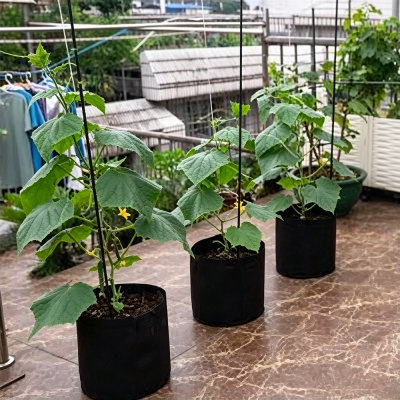
In a hydroponic setup the container holds a coarse substrate rather than soil, and the medium is flushed on a schedule. That makes drainage the deciding property: water has to leave the container as fast as it arrives, or the roots sit in a saturated layer between cycles and the crop suffers. Because the wall is perforated as well as the base, the medium drains in every direction rather than only downwards, and air moves through the substrate between irrigation events. The container is also light, which matters on a bench where a whole run is moved at once, and it is supplied flat so a grower can form the diameters the run needs rather than ordering a single fixed size.
| Model | AP-ZF-001 |
| Material | PE panel, perforated cone wall |
| Construction | Rolled panel with independent base disc |
| Drainage | Free at wall and base |
| Uses | Bonsai, hydroponic growing, nursery tree stock |
| Pricing | USD 0.35 to 0.99 per square metre |
| Packing | Supplied flat, stacked for export |
The same container is used for tree stock standing out through a season. Because it drains on its own it can be set on gravel or on a membrane without a raised tray, and because the wall vents, a container standing in full sun does not build the heat and humidity that a sealed pot holds. That makes it workable for nursery rows where the pots are spaced to the size the plant will reach rather than the size it starts at, and where the gaps between containers have to be wide enough that roots do not meet through the openings. Set out this way, a row of containers behaves much like a field block, with the advantage that the plants can be lifted and sold at any point in the season.
Containers are supplied flat and formed on site, which keeps freight low and allows several diameters to ship on one pallet. Pricing for this model runs from USD 0.35 to 0.99 per square metre with a minimum order of 1000 square metres, samples are available, and delivery runs about 15 days after deposit. Trade coverage of how growers work with container root systems, such as HortiDaily and FreshPlaza, is worth following if you are specifying for more than one crop.
Is this container suitable for bonsai?
Yes. Roots that have been air pruned branch through the ball instead of coiling against the wall, which makes them easier to lift, comb and cut back at repotting.
How does it behave in a hydroponic system?
The wall and base both drain freely, so a flushed medium does not hold a saturated layer between irrigation cycles, and air moves through the substrate as well.
Can the container stand outdoors?
Yes. It drains on its own and can be set on gravel or a membrane without a raised tray through a full season. Tell us the crop and the standing period and we will confirm the size.
Tell us the crop, whether you are growing in soil or in a hydroponic medium, and the container size you need, and we will confirm the specification and the packing that suit your order.
Mark Wu, Co-founder & Technical Director, Sichuan Zhifang Net Industry. 15 years manufacturing agricultural nettings and nursery containers for growers in 32 countries.