

Cell depth is the specification nurseries argue about most, because it decides what can be started and when it has to be moved on. A shallow tray forces a seedling to be transplanted early, before its root system has filled the cell, and an early move costs the plant growth. Ninety millimetres of depth gives a root run roughly twice that of a standard shallow insert, which means a seedling can stay in the tray longer, arrive at transplanting with a complete root ball, and establish without a check. The trays sit directly on a heat mat, so bottom heat reaches the cells evenly across the whole block.
Trays are chosen by cell count far more often than by cell depth, and depth is the specification that decides the schedule. A tray that is too shallow sets the date the seedling has to leave, whether or not the crop is ready, and the plant pays for the difference in its first weeks after transplanting.
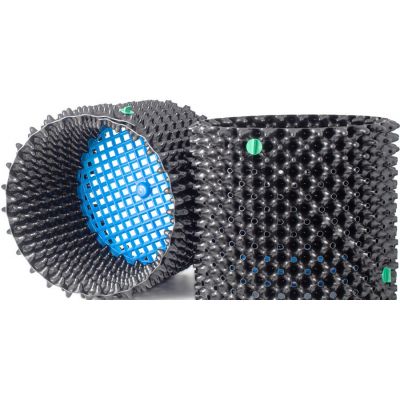
A cell 90 mm deep gives the root roughly twice the vertical run of a shallow insert, and that extra run changes two things. First, the seedling can be held longer without the roots reaching the base and turning, so the transplant date is set by the crop rather than by the tray. Second, the root ball that forms is deeper and holds more medium, which means more water and nutrient carried into the field and less shock at the moment of planting. The tray measures 21.26 by 11.02 by 3.54 inches overall, so it sits on a standard bench or trolley without a custom frame. The same thinking runs through the whole root control container range, and for growers working across several crops it sits alongside the shade net and planting bag ranges.
The tray is designed to stand directly on a heat mat, and the cell geometry matters there. Heat has to reach the medium in every cell, not just the ones over the mat element, so the cells are moulded thin and even and the tray base sits flat rather than on deep feet that would lift it clear of the surface. Bottom heat is what most germination schedules are built around in a commercial nursery, because it brings the medium to temperature without drying the surface layer, and a tray that sits properly on the mat keeps the whole block within a degree or two of the set point.
| Model | NP-005 |
| Material | Plastic |
| Cells | 50 per tray |
| Cell Depth | 90 mm |
| Tray Size | 21.26 x 11.02 x 3.54 inch |
| Shape | Square tray, square tapered cells |
| Colour | Black, grey, blue or as required |
| Season | Four seasons |
| Packing | PP bag or carton, nested for export |
Fifty cells is a middle count, and it suits crops that need depth more than they need cell numbers. Peppers, tomatoes and aubergines all benefit from the extra root run before they are potted on or planted out, and so do brassicas and cucurbits started under cover and moved when the soil warms. Flower starts and herbaceous perennials that resent root disturbance also do better in a deeper cell, because the root ball travels intact. Where a nursery wants higher density for short-cycle crops, the same range is available in other cell counts and the tray footprint stays compatible with standard bench and trolley dimensions.
Standard colour is black, with grey and blue available and custom colours matched on request. The trays are reusable, and being plastic they can be washed and stacked between batches rather than discarded, which matters where trays are handled in volume through a season. Minimum order is 500 pieces with an FOB range of USD 1.2 to 1.6 per piece, samples are available at USD 10 per piece, and delivery runs about 15 days after deposit with L/C and T/T accepted. Trade coverage of how nurseries manage germination and transplant schedules, such as HortiDaily and FreshPlaza, is worth following if you are specifying for more than one crop.
Why does 90 mm depth matter?
It gives the root about twice the vertical run of a shallow insert, so the seedling can be held longer and travels to the field with a deeper root ball and more medium around it.
Will the tray work on a heat mat?
Yes. The base sits flat so heat reaches every cell, which keeps the whole block close to the set point rather than only the cells over the mat element.
Are the trays reusable?
Yes. They are plastic and can be washed and stacked between batches. Tell us the crop and the schedule and we will confirm the cell count and depth that suit it.
Tell us the crop, the cell count and the depth you need, and we will confirm the tray size, the colour and the packing that suit your order.
Mark Wu, Co-founder & Technical Director, Sichuan Zhifang Net Industry. 15 years manufacturing agricultural nettings and nursery containers for growers in 32 countries.