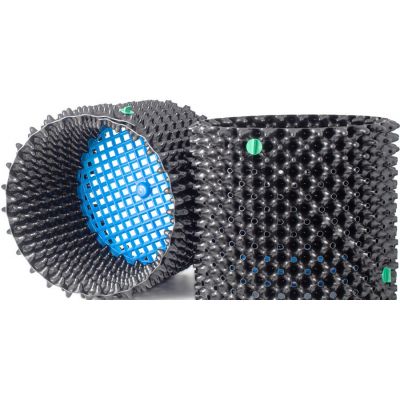


The gap between germination and potting on is where small nurseries lose plants, because the seedling has to be moved from a flat to a pot without interrupting its growth. Buying the tray and the pot as one system removes some of that risk: the cells and the pots come from the same specification, the medium and the watering regime carry over, and the seedling arrives in the pot with the root ball it built rather than one that has been handled twice. The tray cells are square and tapered with base drainage, so a plug lifts whole, and the pots that follow are formed from the same perforated wall as the rest of the range.
Most nurseries buy trays from one supplier and pots from another, and then spend the season managing the mismatch. A plug that is too narrow for the pot leaves an air gap around the roots; a tray that is too shallow forces the seedling out before it is ready. Buying the two together against one specification removes the guesswork.
When the tray and the pot come from the same range the transition is a handling step rather than a change of environment. The medium can be the same mix, the irrigation regime carries over, and the plug that comes out of the tray sits in the pot with the same contact against the wall that it had in the cell. That matters most for species that resent disturbance, because a seedling that is moved without a check keeps growing rather than spending a fortnight rebuilding. The same approach runs through the whole root control container range, and for growers working across several crops it sits alongside the shade net and planting bag ranges.
The mechanics of a clean move are simple and worth stating. The cells are square with tapered walls and a drainage hole at the base, so a plug can be pushed out from below in one movement, and square cells mean the root mass already has corners, which is closer to the shape it will occupy in a round or square pot than a cylinder would be. Once the plug is in the pot, the perforated wall continues training the roots, so the plant does not lose the benefit it gained in the tray. In practice this keeps the two stages consistent rather than treating germination and growing on as separate operations.
| Model | RC-016 |
| Material | Plastic |
| Cells | 25 to 49 cells per tray |
| Cell Shape | Square, tapered, with base drainage |
| Pot Height | 15 cm to 60 cm |
| Drainage | Good, perforated wall and base |
| Features | Detachable, heightened, high temperature resistant |
| Packing | PP bag or carton, nested for export |
Square cells exist for a practical reason: a tray of round cells wastes the space between them, and on a bench where every square centimetre is paid for that waste compounds across a block. Square cells also make the tray easier to fill and the plug easier to push out, because the sides are parallel and a plunger only has to overcome the taper. The same geometry matters when the seedlings reach the pots, since square pots can be set edge to edge without gaps while still leaving room for the root balls to develop without touching.
The set is supplied as a tray and pot combination, with the tray in any cell count from 25 to 49 and the pot at 15 to 60 cm. Minimum order is 500 pieces with an FOB range of USD 0.2 to 0.3 per piece, samples are available, and delivery runs about 15 days after deposit with L/C and T/T accepted. Because the tray and pot are ordered together, it is worth fixing the cell count and the pot size against the crop at the same time so the two arrive matched. Trade coverage of how nurseries manage propagation, such as HortiDaily and FreshPlaza, is worth following if you are specifying for more than one crop.
Can I buy the tray and the pot separately?
Yes, but ordering them together is worth considering because they are specified against each other, so the plug fits the pot without an air gap.
Why are the cells square rather than round?
Square cells use the bench area without waste between rows, and they also make the plug easier to push out and closer to the shape it occupies in the pot.
What cell count should I choose?
It depends on the crop and how long the seedling stays in the tray. Tell us the species and the schedule and we will confirm the count and the pot size.
Tell us the crop, the cell count and the pot size you need, and we will confirm the tray, the wall thickness and the packing that suit your order.
Mark Wu, Co-founder & Technical Director, Sichuan Zhifang Net Industry. 15 years manufacturing agricultural nettings and nursery containers for growers in 32 countries.