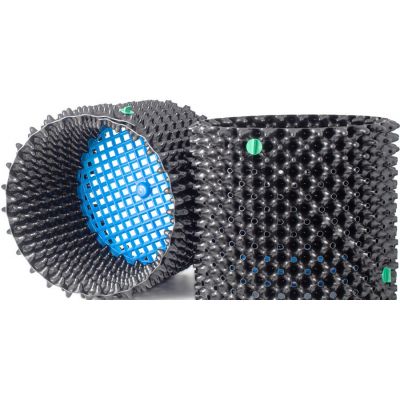


Three plastics turn up in air pruning containers and they are not interchangeable. Polypropylene is stiff and holds a sharp cone shape well, which suits containers that are formed once and kept; it also tolerates steam cleaning. PVC is flexible and tougher at low temperatures, so it takes knocks on a cold yard without cracking, which is useful where containers are handled outdoors through winter. HDPE sits between the two on stiffness and has the best UV behaviour of the three when it is stabilised, which is why outdoor ranges are usually specified in it. The choice follows where the container stands and how it is handled rather than the price alone.
Containers in this range are quoted in three plastics and the prices are close enough that the material is usually chosen on behaviour rather than cost. Getting that choice right matters, because a container that cracks in its second winter costs more than the difference between two resins.
Polypropylene is the stiffest of the three and takes a crisp moulding, so a cone pattern stays sharp and the container holds a true circle under load. It also takes heat, which makes it the natural choice where trays or pots are steam cleaned. PVC is the most flexible and keeps that flexibility when it is cold, so it survives being knocked about on a winter yard, though it is softer under a full load. HDPE is the middle ground on stiffness and the strongest on UV performance once it is stabilised, which is why containers that stand outdoors for a full season are usually specified in it. Where cost is the deciding factor and the container is used under cover, recycled grades are available and behave close to virgin material indoors. The same material thinking runs through the whole root control container range, and for growers working across several crops it sits alongside the shade net and planting bag ranges.
UV resistance is often talked about as if it were a coating, and it is not. It is built into the resin, which is why a stabilised HDPE keeps its strength after a season in the sun while an unstabilised polymer of the same thickness will chalk, stiffen and crack. That distinction matters most at the cone pattern, because the wall is thin at the openings and a material that embrittles there will tear at the first lift. For containers used under cover the requirement is lower, and an indoor range can be specified in a plainer grade without cutting life. The point is to name where the container will stand before naming the material.
| Model | RC-018 |
| Material | PP, PVC or HDPE, UV stabilised for outdoor use |
| Height | 15 cm to 60 cm |
| Diameter | 15 cm to 200 cm |
| Shape | Round |
| Features | Detachable, heightened, high temperature resistant |
| Drainage | Good, perforated wall and base |
| Packing | PP bag or carton, palletised for export |
Material and construction go together. A stiff resin suits a container that is formed on site and expected to hold its shape, because the panel has to spring back into a true circle and stay there under wet medium. A more flexible resin suits containers that are handled roughly and often, where surviving a knock matters more than holding a precise section. Both are supplied as flat panels with a separate base disc, so the same logistics apply whichever is specified, and both use the same perforated wall pattern so the air pruning behaviour is unchanged.
Sizes are made to requirement from 15 cm to 200 cm diameter and 15 cm to 60 cm high. Minimum order is 500 pieces with an FOB range of USD 1.2 to 1.6 per piece, samples are available, and delivery runs about 15 days after deposit with L/C and T/T accepted. Where the material matters to a specification, it is worth naming it on the order rather than leaving it to the supplier, because the difference only shows up in the second season. Trade coverage of how growers choose growing media and containers, such as HortiDaily and FreshPlaza, is worth following if you are specifying for more than one crop.
Which plastic should I choose?
PP where the container stays rigid and may be steam cleaned, PVC where it is handled roughly in cold weather, and stabilised HDPE where it stands outdoors through a full season.
Is UV resistance a coating?
No. It is built into the resin, which is why a stabilised material keeps its strength after a season in the sun while an untreated one embrittles at the thin points of the cone pattern.
Are recycled grades available?
Yes, and they behave close to virgin material in covered growing. For outdoor use a stabilised virgin grade is normally the better choice. Tell us where the container will stand and we will confirm.
Tell us where the containers will stand, how they will be handled and the size you need, and we will confirm the material, the wall pattern and the packing that suit your order.
Mark Wu, Co-founder & Technical Director, Sichuan Zhifang Net Industry. 15 years manufacturing agricultural nettings and nursery containers for growers in 32 countries.