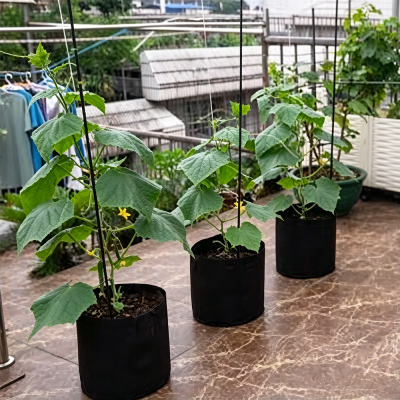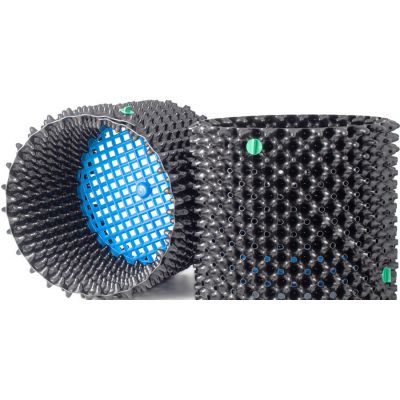


Root volume decides what a programme can sell, and this air pruning container covers the whole ladder: from compact 2 gallon rounds for propagation to 45 gallon units that take a tree through to sale size. The slotted wall stops root tips wherever it sits, so every size fills with fibrous, self-supporting roots instead of coils, and the open base keeps air and drainage moving even on a packed bench. The PE/PVC body holds its shape through seasons of greenhouse work, UV exposure and transplanting. Diameters run 15 to 200 cm, with base plates to match.
Most programmes end up buying a different container for every stage, and a different root quality to match. This range keeps the whole production ladder on one wall system instead: compact 2 gallon rounds for plugs and starts, mid sizes for shrubs and liners, and 45 gallon units that hold trees through to sale. Every size returns the same fibrous, branched roots that lift out clean and establish without a check.

Capacity is the quickest way to specify a root pruning container, because the gallon figure tells you how much root room the plant actually gets. The ladder starts at 2 gallon rounds for plugs and vegetable starts, steps through 5.6 and 13.3 gallon sizes for shrubs and liners, and finishes at 25.9 and 44.8 gallon units that hold trees up to sale. Every size is built from the same flat panel and base plate, so a programme moves a plant up the ladder without changing its growing system. The same wall runs across the air pruning pot line, from propagation rounds to transplanting containers.


Air pruning does not change with capacity: a root tip that meets the slotted wall dries and branches whether the container holds two gallons or forty five. What changes is scale. A large unit has more soil to drain and more heat to shed, and the open grid at the base is what keeps air moving through the middle of a big root ball. The effect is the one growers look for in every air pruning system: tips stop at the wall, the plant answers with new branching, and the root ball stays together at transplant. The PE and PVC body holds its panel shape season after season, so the pruning stays consistent from the first planting to the tenth.


| Use | Greenhouse horticulture, tree transplanting, hedges |
| Material | PE, PVC |
| Diameter | 15-200 cm |
| Height | 15-60 cm |
| Thickness | 0.6-1.5 mm |
| Base diameter | 15-60 cm |
| Colour | Black, other colours on request |
| Customisation | Accepted |
| Samples | Available |
| Container | Volume (litre) | Volume (gallon, approx) |
| 20 x 20 cm | 6.28 | 1.66 |
| 30 x 30 cm | 21.20 | 5.6 |
| 40 x 40 cm | 50.24 | 13.27 |
| 50 x 50 cm | 98.13 | 25.92 |
| 60 x 60 cm | 169.56 | 44.79 |

The greenhouse is where the range starts its working life: ornamentals, flower starts and vegetable seedlings on benches where containers sit close together. The open wall keeps air and drainage working even at that spacing, so a packed bench holds its quality. From there the same pots move outside with the work they were built for: hedgerow lines, orchard establishment and street tree transplanting, where the root ball has to hold together through lifting, transport and replanting. Nurseries taking trees into larger containers or into the field run the same wall system at the big end, and the commercial tree and nursery range covers those sizes in detail.

Orders rarely run to one size, so mixed pallets are normal: panels and base plates ship flat and nested, which keeps freight down and storage compact between seasons. Packing runs to your own label, and samples let you test a wall against your own bench and watering plan before a bulk order. For soft-wall containers in the same programme, the planting bag range covers the flexible alternative. Ongoing coverage of greenhouse practice and nursery trade news runs at HortiDaily and FreshPlaza.
How do I choose between the sizes?
Match the gallon figure to the root volume the plant will be sold at: 2 to 5.6 gallon rounds for plugs and starts, 13 to 26 gallon units for shrubs and liners, and the 45 gallon size for trees that stay in the container up to sale.
Do the pots perform in a dense greenhouse?
Yes. The wall keeps airflow and drainage working even when containers touch, which is why the range is used on packed benches as well as in open field rows.
Can sizes be mixed in one order?
Yes. Panels ship flat and nest, sizes can be combined on a pallet, and custom diameters are accepted beyond the standard ladder.

Share your plant list, target sizes and volumes and we will prepare the packing plan and lead time.
Mark Wu, Co-founder & Technical Director, Sichuan Zhifang Net Industry. 15 years manufacturing agricultural nettings for growers in 32 countries.