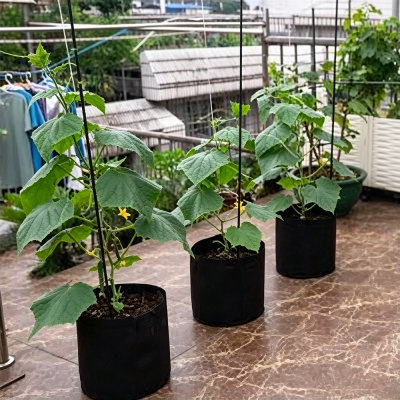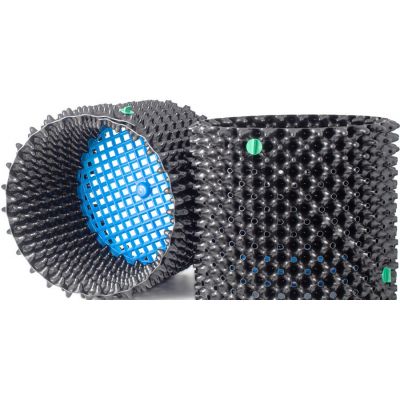


A root that reaches the wall of a smooth pot will circle it, and every turn after that adds a root that has to be teased apart at planting. An air pruning pot works differently. The wall carries a field of embossed cones with an opening at each tip, so a root that grows into one meets air rather than soil and stops. The plant answers by pushing new roots from further back along the same root, and the result is a dense fibrous ball instead of a coiled one. Diameters run 15 to 200 cm and heights 15 to 60 cm, in PE and PVC with a choice of black or white.
Most nursery losses at planting time are root problems that were built into the pot months earlier. A plant grown in a smooth-walled container sends its roots outward until they meet the wall, then follows it in a circle. By the time it is lifted out, the root ball is a coiled mat that has to be cut or teased before it will grow away, and the plant spends its first season recovering instead of growing.
The wall of an air pruning pot is not smooth. It is covered with embossed cones, each one open at the tip, and behind them the moulding leaves the structure rigid enough to hold its shape under wet compost. When a root grows into one of those cones, the tip reaches the opening and meets air instead of soil. The tip stops elongating; that is the whole mechanism. Nothing is cut and nothing is bruised, so no wound is opened for disease, and the plant simply redirects its growth. The same idea runs through the whole root control container range, and for growers working across several crops it sits alongside the shade net and planting bag ranges.
When the tip stops, the plant does not stop. It responds by breaking new roots from further back along the same root, and each of those behaves the same way when it reaches a cone. The practical result is a root system that branches close to the trunk instead of running to the edge, which is what makes the survival rate difference nurseries report after transplanting: roots are already distributed through the whole root ball rather than wrapped around its outside. Densities of 25 to 49 cells and diameters from 15 cm up to 200 cm let the same design serve a seedling tube and a tree container.
| Model | RC-011 |
| Material | PE, PVC |
| Diameter | 15 cm to 200 cm |
| Height | 15 cm to 60 cm |
| Thickness | 0.6 mm to 1.5 mm |
| Base Diameter | 15, 20, 30, 40, 50, 60 cm |
| Shape | Round |
| Colour | Black, white or as required |
| Packing | PP bag or carton for export |
The volume a pot holds is what decides the crop it suits, and the common sizes run from a seedling tube to a tree container. A 20 by 20 cm pot holds about 6.3 litres, which covers vegetable and flower seedlings. The 30 by 30 cm size holds 21.2 litres and suits shrubs and small fruit trees. At 40 by 40 cm the volume reaches 50.2 litres, enough for a young tree through its first seasons, and the 50 and 60 cm sizes hold 98.1 and 169.6 litres for tree transplanting and hedging work. Because the wall is rigid and the cones are moulded in, the pot can be lifted and moved with the root ball intact rather than being cut away.
Air pruning containers are used where a plant has to be held for a season or more and then moved without a setback: field-grown tree stock, hedge plants, and nursery rows that are lifted and sold on. Because the roots are already fibrous and distributed, the plant can be lifted and planted without root pruning on site, and the pot can be reused the following season. Minimum order is 500 pieces with an FOB range of USD 2.4 to 6.8 per piece, samples are available, and delivery runs about 15 days after deposit with L/C and T/T accepted. Trade coverage of how growers manage nursery stock, such as HortiDaily and FreshPlaza, is worth following if you are specifying for more than one crop.
How does air pruning actually work?
The root tip grows into an embossed cone and meets air at the opening, which stops it elongating. The plant then breaks new roots further back along the same root. Nothing is cut, so no wound is left.
What sizes do you make?
Diameters of 15 cm, 20 cm, 30 cm, 40 cm, 50 cm and 60 cm as standard, with 15 to 200 cm available by requirement, and heights of 15 to 60 cm. Tell us the crop and the season length and we will confirm the volume.
Are the pots reusable?
Yes, the wall is rigid and the cones are moulded into it, so the pot keeps its shape through a season and can be lifted, cleaned and used again.
Tell us what you are growing, the season length and the pot volume you need, and we will confirm the diameter, height and thickness, plus the packing that suits your order.
Mark Wu, Co-founder & Technical Director, Sichuan Zhifang Net Industry. 15 years manufacturing agricultural nettings and nursery containers for growers in 32 countries.