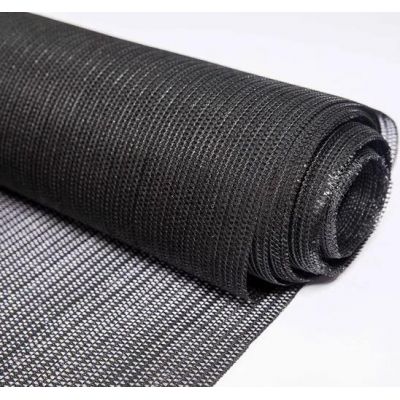


A baler does not care what shape the bale is, but the net does. Round and square bales load the wrap in different directions, so the roll that suits one machine is not automatically the right choice for the other. Width, roll length and yarn tension are the three settings that have to match the baler before anything else is decided. For dry hay the 8.33 gsm mesh is enough; dense silage and heavy straw need the 10 gsm roll. UV stability is in the yarn rather than a coating, so bales can stand in the open through the season. Widths run 1 m to 1.7 m and roll lengths 2000 m to 3000 m.
A round bale presses the net against a curved surface that is still moving as it turns. A square bale presses it flat and holds it under a different load. The same roll can serve both, but only if the width, the roll length and the yarn tension are chosen for the baler rather than copied from a neighbour. Getting those three right is most of what makes a wrap stay put.
On a round baler the net is laid across a rotating cylinder, so the wrap is held by hoop tension and the mesh is pulled in two directions at once. The roll width has to cover the full bale face in one pass, which is why round balers commonly run wide rolls. On a square baler the net is applied to a flat face under compression, and the load is closer to a straight pull across the width; a narrow roll that matches the chamber works better here, and the roll length matters more because square bales are often wrapped in longer runs. Large square bales of silage are the heaviest case of all, and they are the reason the 10 gsm mesh exists. Hay roll net and large square bale net are not two products, they are the same mesh sized for two machines.
The practical order is width first, then roll length, then weight. Width is fixed by the baler chamber: 1.22 m or 1.23 m suits common metric round balers, 1.62 m and 1.7 m suit the wider chambers, and 1 m covers the narrow ones. Roll length is a cost question rather than a technical one, since 2000 m, 2500 m and 3000 m rolls are the same mesh on different cores, but a longer roll means fewer roll changes in a working day. Weight comes last and follows the crop. Farms running the bale net wrap range alongside the shade net and planting bag ranges follow the same order, because the baler sets the limit before the material does.
| Material | HDPE, warp knitted |
| Weight | 8.33 g/m2 or 10 g/m2 |
| Net Width | 1 m, 1.22 m, 1.23 m, 1.62 m, 1.7 m or by requirement |
| Roll Length | 2000 m, 2134 m, 2500 m, 3000 m or by requirement |
| Bale Types | Round balers and square balers |
| UV Treatment | UV stabilised in the yarn |
| Packing | Rolls on cardboard tubes, palletised for export |
Mixed farms rarely run one crop, so the sensible order covers the range rather than a single roll. Dry grass hay takes the 8.33 gsm mesh, because the bale is light and the wrap only has to hold shape. Straw is lighter still but abrasive, so the same mesh is used with attention to the tension setting. Silage and haylage are the heavy end: the bale is wet, dense and often double wrapped, and the 10 gsm roll holds the load without stretching. If the farm wraps in coloured film over the net, the net colour itself is usually left neutral, though coloured bale wrap is available where stock control or a customer preference calls for it. Delivery runs about 15 days after deposit with T/T and L/C accepted.
Rolls ship on cardboard tubes and palletise for export, giving 190 to 210 rolls in a 20 ft container and 490 to 510 in a 40 HQ. Minimum order is 2000 kg, which is worth working back to bale count: at two to three turns per bale the roll length sets how many bales a pallet will cover, and that number is what the order should be built on. Trade coverage of how growers handle bales through the season, such as HortiDaily and FreshPlaza, is worth following if you are specifying for more than one crop.
Can the same roll be used on a round baler and a square baler?
The mesh is the same, but the width and roll length usually are not. A square baler has a fixed chamber width, so the roll has to match it, while round balers often take a wider roll that covers the face in one pass. Tell us the baler make and chamber width and we will confirm the roll.
Which weight suits silage?
Silage and heavy straw bales take the 10 gsm mesh. Dry hay takes 8.33 gsm. The difference is the load the wrap carries in storage rather than the baler itself.
Is the net UV treated?
Yes. UV stability is built into the yarn rather than applied as a coating, so the wrap does not rely on a surface layer that can wear through. That matters for bales stored in the open for months.
Tell us the baler type, the chamber width and the crops you wrap, and we will confirm the mesh weight, the roll width and length, and the packing that suit your order.
Mark Wu, Co-founder & Technical Director, Sichuan Zhifang Net Industry. 15 years manufacturing agricultural nettings for growers in 32 countries.