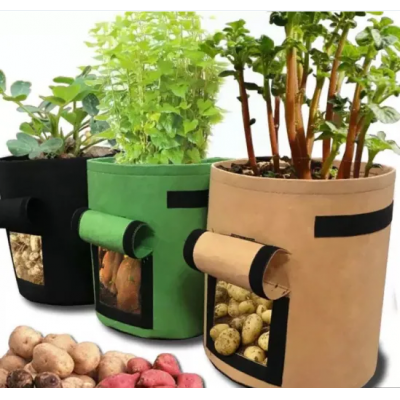


On a large bag the handle is not a convenience, it is a decision about how the bag will ever be moved. A 100 gallon bag full of wet medium cannot be lifted by one person at all, and if it is never going to be lifted then a handle is a cost with no benefit. Where it will be moved, the load concentrates at the handle attachment, and that is where a big bag splits. That is why the bag comes in three configurations: no handle for bags that stay put, standard handles for the middle sizes, and a reinforced attachment for the large sizes that are lifted or slung. The fabric is double stitched non woven, UV stabilised.
Small bags are all moved the same way; large ones are not. Past a certain size the bag stops being something carried and becomes something that is either left where it was filled or moved with equipment, and that changes what the handle is for.
The three configurations match three real situations. A large bag that is filled in place and harvested in place does not need a handle at all, and leaving it off removes both a cost and a weak point. A bag that gets moved by hand between seasons wants standard handles, which is the middle sizes. A bag that is heavy enough to be slung or lifted with assistance wants the reinforced attachment, because that is where the load concentrates and where a bag with a plain handle will eventually tear out of the wall. Ordering the right one comes down to one question asked before the order rather than after: will this bag ever be lifted, and by what.
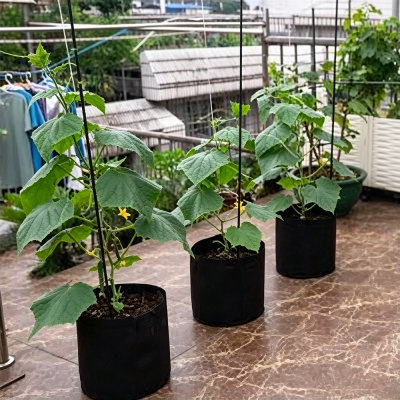
The bags are used in high density nursery production where stock is held for more than one season, in orchard establishment where trees are grown on before planting out, and in commercial growing operations where containers are filled and emptied in place. The fabric is UV stabilised and reusable, which is what makes the per season cost work on a large container; a bag that lasts three cycles costs a third as much per cycle as one that does not. The porous wall does the same job it does at smaller sizes, air pruning the roots that reach it and encouraging a taproot that will establish after planting. Growers ordering for the same ground often add a planting bag for the smaller stages, and where nursery stock also needs shade, the shade net range covers that separately.
| Model | GB-033 |
| Material | Double stitched non woven fabric, UV stabilised |
| Capacity | 15 to 200 gallon standard, 1 to 400 gallon to order |
| Handles | No handle, two handle, or reinforced two handle |
| Colour | Black, or to your requirement |
| Reuse | Reusable, lowers operational cost per season |
| Packing | Bag, pallet or carton; folds flat |
| Sample | Free sample available |
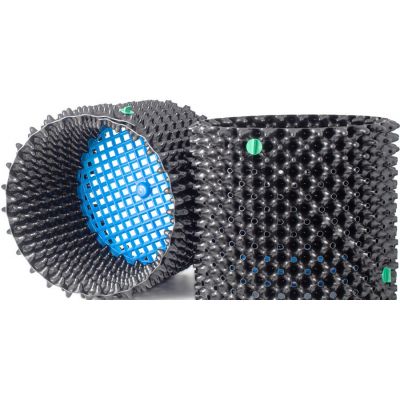
At the large sizes the bag is carrying a load that would be measured in hundreds of kilos when wet, and that load is not evenly shared. It concentrates at the base seam and at whatever the bag is lifted by, which is why both are double stitched and why the handle attachment is offered in a reinforced version. The fabric is also the reason a large container works at all: a sealed pot of this size would hold water at the base and sour the roots, whereas a porous wall lets excess water drain and keeps air moving through the medium. Where a round rigid container is wanted instead, a grow bag with air pruning seams is also available.
Standard capacities run from 15 to 200 gallon, with smaller and larger bags made to order across the full range. Handle configuration, colour and logo are all set with the order, and a free sample is available so the fabric and the stitching can be checked before a bulk run. The bags fold flat when empty, which matters on a large size because the volume saved is greater than on a small one. Tell us the crop, the capacity, whether the bag will be lifted and the quantity, and we will confirm the specification. Buyers tracking what is going into tree nurseries and commercial growing can follow trade coverage such as HortiDaily and FreshPlaza for what growers are installing.
Should I order handles on a large bag?
Only if the bag will ever be lifted. A bag filled and harvested in place does not need them, and leaving them off removes a weak point. Tell us how the bags are moved and we will advise.
What is the reinforced handle for?
It carries the load where a standard attachment would tear out of the wall, which is the failure point on a heavy bag. It is worth specifying on any size that is lifted wet.
How long will a large bag last?
The UV stabilised fabric is reusable across seasons, which is what brings the per season cost down. Tell us the exposure and the load and we will confirm the grade.
Tell us the crop, the capacity, whether the bag will be lifted and the quantity, and we will confirm the specification, the sample and the packing that suit your order.
Mark Wu, Co-founder & Technical Director, Sichuan Zhifang Net Industry. 15 years manufacturing agricultural nettings for growers in 32 countries.