

Root control is usually justified on plant health and then bought on price, which is the wrong way round. The case for a perforated container has three parts. The first is labour: a fibrous root ball can be lifted and dispatched without a root pruning bench, removing a step from every plant. The second is loss: fewer plants are culled for rotted roots or lost to transplant shock, because the roots travel whole into the field. The third is media and water, since a wall that drains does not hold a saturated layer. Add the three across a block and the container pays for itself before the season ends.
Any case for a growing container has to end in a number, and for a perforated container the number is a sum of three things that are normally tracked separately. Taken one at a time none of them looks decisive; taken across a block for a season, they are what the container is actually bought for.
The first line is labour. A plant whose roots have been trained by air does not need a root pruning bench at dispatch, because the root ball is already fibrous and distributed, so the step that normally sits between lifting and packing disappears from the schedule for every plant on the block. The second line is loss. A root system that travels whole into the field establishes faster, and fewer plants are culled for rotted roots before they are sold, which matters most in a wet season. The third line is media and water. A perforated wall drains in every direction, so a heavy irrigation pass does not leave a saturated layer in the base of each pot. The same reasoning runs through the whole root control container range, and for growers working across several crops it sits alongside the shade net and planting bag ranges.
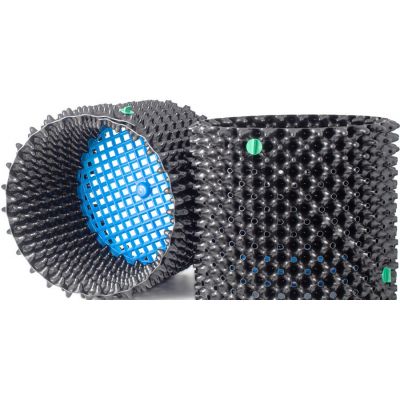
The wall is supplied flat and formed on site, so one specification covers the whole ladder rather than one size. At the small end it makes a propagation cell; in the middle it makes the container a shrub or a young tree grows in for a season; at the large end it makes a tree container for stock that will be sold as a specimen or planted directly into a landscape scheme. Because the panel is formed rather than moulded as a solid body, a grower can order the diameters the plan calls for, and a single shipment can carry more than one size. The base disc is matched to whichever diameter is chosen, and the wall pattern is the same at every size, so the root behaviour does not change as the container grows.
| Model | ZF-AP-012 |
| Material | PE panel with perforated cone wall |
| Construction | Flat panel formed on site, independent base disc |
| Drainage | Free at wall and base |
| Uses | Propagation, nursery stock, tree and landscape planting |
| Pricing | USD 0.35 to 0.99 per square metre |
| Packing | Supplied flat, stacked for export |
Two buyer types use the same container for different reasons. A production nursery uses it because the plant can be held for a season and then lifted and dispatched without extra handling, which shortens the cycle between lifting and sale. A landscape contractor uses it because plants that arrive with a fibrous root ball establish without a check, which matters where a scheme has to look finished in its first season and where replacing a failed plant costs more than the plant itself. Both benefit from the fact that the container can stand outdoors, set on gravel or a membrane, without a raised tray.
Pricing for this model runs from USD 0.35 to 0.99 per square metre with a minimum order of 1000 square metres, samples are available, and delivery runs about 15 days after deposit. Because the container is priced by area and supplied flat, it is worth converting the planting plan to square metres before confirming, so the quantity matches the diameters actually needed. Trade coverage of how nurseries and landscape growers manage root systems, such as HortiDaily and FreshPlaza, is worth following if you are specifying for more than one crop.
How is root control a cost saving rather than a plant benefit?
It removes the root pruning step at dispatch, reduces plants lost to rotted roots or transplant shock, and stops the medium holding a saturated layer. Those three are the saving.
Can one container type cover propagation and tree stock?
Yes. The panel is formed on site, so the same wall makes a propagation cell, a shrub container or a tree container depending on the diameter chosen. Tell us the plan and we will confirm the sizes.
How do I calculate the quantity?
The container is priced by square metre, so convert the planting plan to square metres using the diameters you need. Send us the plan and we will confirm the quantity and the packing.
Tell us what you are growing, the size the plants will reach and the quantity, and we will confirm the diameters, the base discs and the packing that suit your order.
Mark Wu, Co-founder & Technical Director, Sichuan Zhifang Net Industry. 15 years manufacturing agricultural nettings and nursery containers for growers in 32 countries.