
By Mark Wu, Co-founder & Technical Director, Sichuan Zhifang Net Industry Co., Ltd.
A root control container has one job. Put a wall where air can reach a root tip, so the tip stops instead of turning.
The cone pattern, the wall gauge, the base, the screws, all of it exists to make that one thing happen reliably for twenty years. None of it survives bad filling. I have seen growers buy a good pot and get a mediocre root ball out of it, and the pot was not the reason.
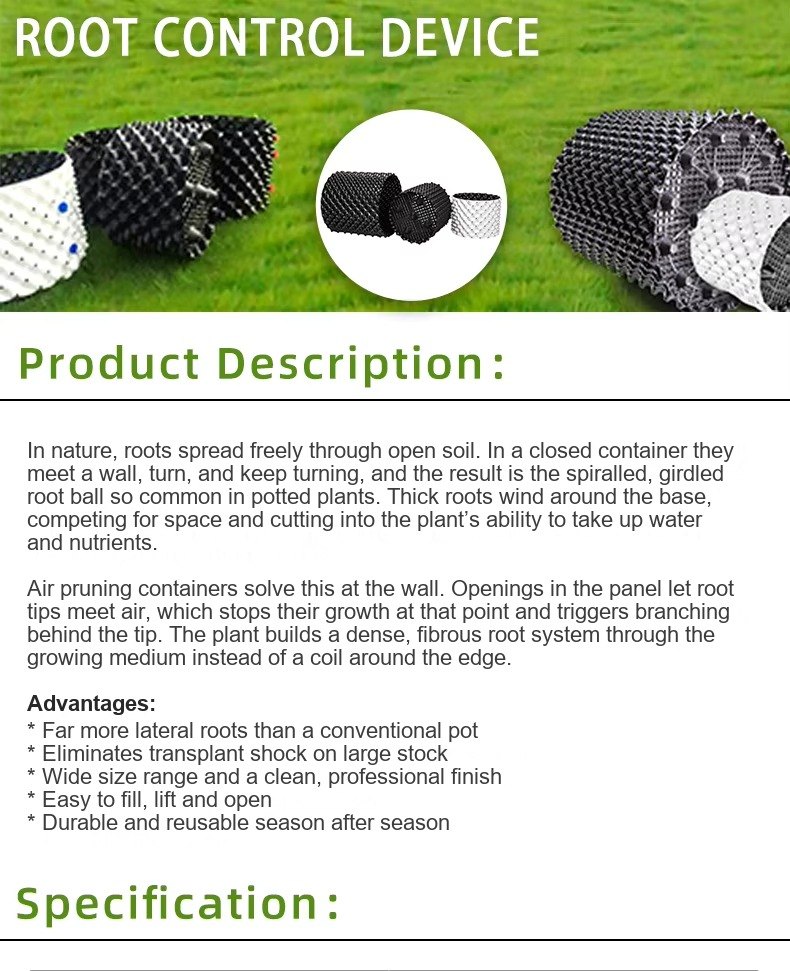
Look inside an assembled pot and you see a grid of cones with their tips cut off. Those are not decoration and they are not drainage.
Each cone is a cavity that should be full of growing media. A root grows out from the main mass, enters the cavity, follows it to the opening, meets dry air at the tip and stops. The plant then pushes new roots from behind that point. That is the whole trick, and it only happens if the cavity is filled.
Leave the pockets empty and the wall in front of the root is still there, but it is a smooth surface with holes behind it rather than a series of tunnels. You get some pruning, because a root will still find an opening eventually. You do not get the density the container was designed for.
The mix has to be pressed into each row as you go up. Not shaken in, not poured and hoped.
I fill in layers of about ten centimetres and firm each one against the wall with my fingers, working around the circumference before moving up. It takes longer than dumping a bucket in. It is also the difference between a pot that works and a pot that looks like it works.
Wet the mix first. Dry mix will not stay in a cone, and if it does stay it will shrink away from the wall later, which brings us to the water problem.
The side wall is not symmetrical. The cone tips face inward, toward the root ball, and the smooth side faces out. Assembled the wrong way round, the inside of the pot becomes a nearly flat surface and the pockets stick out into the air doing nothing at all.
This is easier to do than it sounds, especially with a flat-packed kit and a helper who has not built one before. Check the first pot of every batch yourself. Look down into it. If the inside looks like a plastic sheet with holes, stop and turn the wall around.
The overlap matters too. The two ends should meet with the overlap running in the direction the manufacturer cut it for, not reversed. Reversed, the seam is weaker and the last column of cones sits at an odd angle.
Two things happen when you move a crop into air pots, and both are about water.
First, the pot dries faster. Water leaves through the cone openings, so the wall strip dries before the centre does, and that is normal.
Second, and this is the one that catches people, peat and coir shrink when they dry. The mix pulls away from the wall, a gap opens behind the cones, and the next irrigation runs straight down that gap and out of the side holes. The plant looks overwatered and underwatered at the same time, because the water never went where you aimed it.
The fix is boring. Pre-wet the media before filling. Water in two short passes rather than one long one. If the gap has already formed, water slowly enough that the mix can reabsorb instead of channelling. On a large block, drip lines are worth the pipe, because hand watering into a shrunken pot wastes most of the can.
The container costs more than a bag and it lasts far longer, so the arithmetic only works for certain crops.
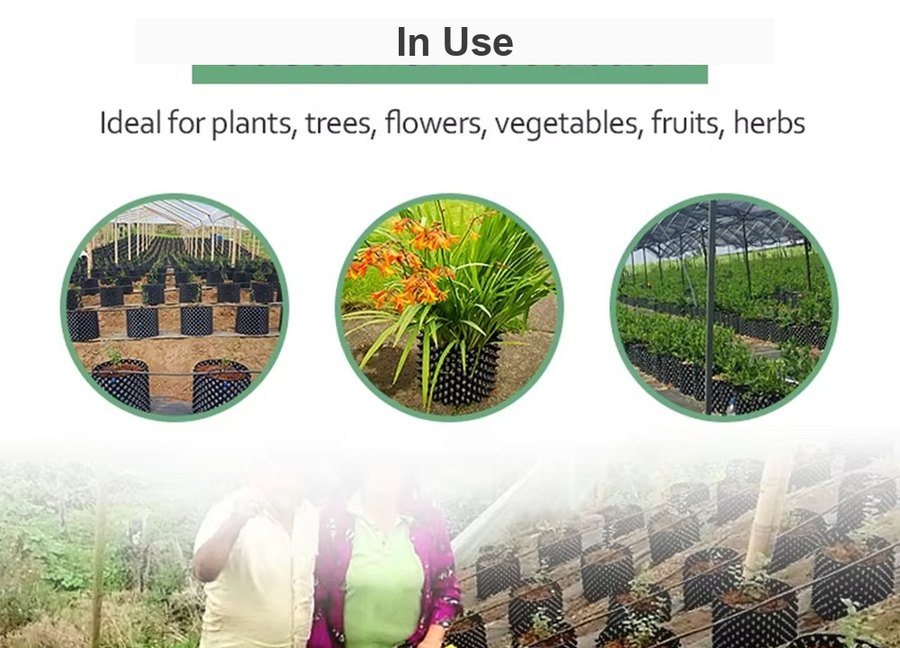
It works for trees, shrubs, perennials and anything that spends a season or more in the same container. It works for holding stock, the plants a nursery bought in and cannot put in the ground yet, because they keep developing instead of sitting still. It works for over-wintering, where the root system has months to build before spring.
For a fast annual crop that ships in eight weeks, the pot still does its job. Whether it pays depends on how many seasons you get out of it, and that depends on handling more than on the pot.

Empty, knock out the root ball, then look at three things. The screw threads, which is where a pot fails first. The cone tips, which crack if the pot has been thrown rather than stacked. The fold, which goes white before it splits.
Clean pots stack flat and take almost no shed space. Store them on a pallet, not in a pile on the floor, because a pot that gets stood on is a pot that leaks at the base later.
Sichuan Zhifang Net Industry Co., Ltd. has been making root control containers and agricultural netting since 2011, from a plant of nearly 10,000 m² with more than 50 production lines. We supply growers in 32 countries, and every carton carries a ZF security label inside the pack. Rose propagators in Yunnan using our containers report markedly better strike rates than they got from conventional pots, mostly because the wall does what it is supposed to do and the filling was done with some care. Root control containers are built for 20 years and beyond in normal nursery use.
For the top two rows, yes. Below that, a filling collar or a vibrating table does most of the work, but someone still has to firm the mix against the wall. If a supplier tells you the pot fills itself, they have not filled one.
You can. Watch the shrinkage. A mix that holds its structure stays in the cones; a light peat mix will pull away once it dries and start channelling water.
Our own containers are built for twenty years and beyond in normal nursery use. In practice the limit is handling, not material. The range of gallon sizes is here if you are matching pots to a crop plan, and the wider container range covers the taller sizes used for trees.


