
By Mark Wu, Co-founder & Technical Director, Sichuan Zhifang Net Industry Co., Ltd.
Ask anyone why they bought a root control container and they will say the same thing. It stops roots circling. True, and it is only half of what the wall does.
The other half is quieter and, in a wet climate, worth more. The holes let the root zone breathe.
Roots respire. They take up oxygen and release carbon dioxide, the same as the rest of the plant, and they do it in the dark under a lid of wet media where nothing moves.
In a solid pot, the only surface that exchanges gas is the top of the media. Everything below that is a sealed column. As long as the mix drains and the plant is watered like a plant and not like a swamp, that is enough, because oxygen diffuses down slowly and the roots nearest the surface use most of it.
When it is not enough, the plant tells you in a way that looks like a disease. Lower leaves yellow, growth stalls, roots at the bottom turn brown and slip their skin. Growers reach for a fungicide. Usually the problem is that the bottom of the pot has been out of air for a week.
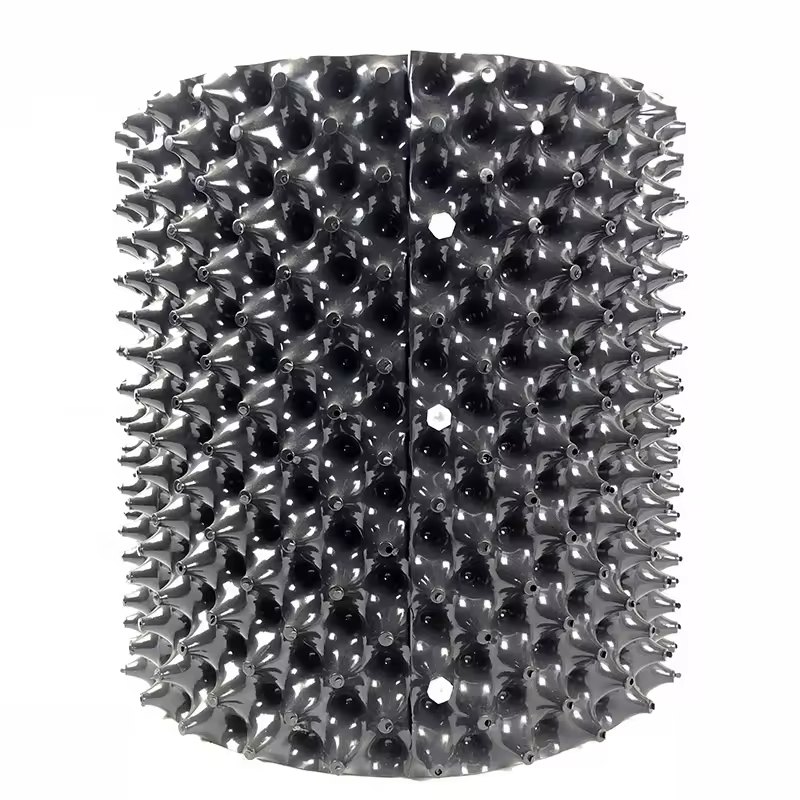
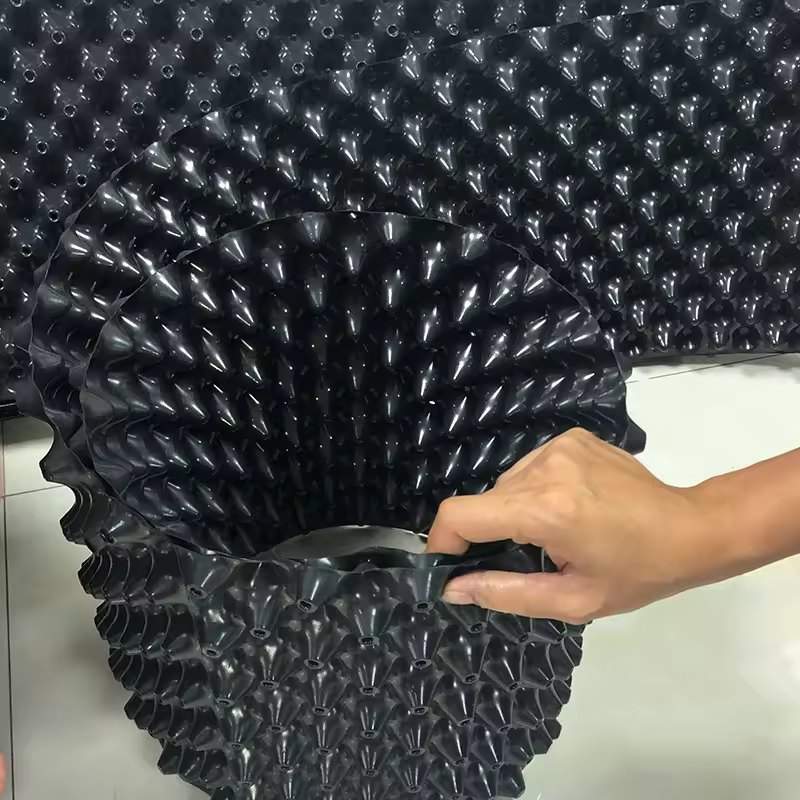
A perforated wall opens the whole side of the column to the atmosphere. Not much air moves through a cone opening on a still day, but it does not need to. What matters is that the path is short. Instead of oxygen diffusing half a metre down through wet media, it diffuses two centimetres sideways through a hole.
That changes the arithmetic of how wet a mix you can get away with. In a solid pot, a heavy mix plus daily watering is a slow drowning. In an air pot the same mix has an escape route, and the lower root zone stays habitable.
Aerobic microbes need oxygen as much as the roots do. The ones that cycle nutrients and suppress disease are aerobic. The ones that cause damping off, root rot and the sour smell in an overwatered pot are the ones that thrive when oxygen runs out.
So the wall is doing two jobs at once. It keeps the root zone aerobic near the boundary, and it keeps the microbial population in the form you want. That is the part nobody mentions in the marketing, because it is harder to photograph than a fat white root.
It also explains something growers notice without being able to explain. Plants in air pots often come through a wet season better than plants in solid pots of the same size, same media, same irrigation. The roots are not bigger in the first month. The root zone is just less suffocated.
A film of water across a hole is a closed hole. Water's surface tension will bridge a small opening and hold there, and in a pot that has just been flooded from the top, every cone below the water line is briefly sealed.
That is fine if it drains. It is not fine if the mix holds water and the pot stands in a puddle, which is exactly what happens on a concrete floor with no pallet under it.
Two habits keep the wall working. Water in two passes rather than one flood, so the media absorbs instead of running straight through. And keep the base off the ground, so the drainage path is real and not a puddle.
A coarse, structured mix and an air pot work together. A fine, silty mix plugs the cone openings from the inside, and once a cone is blocked with compacted media, that opening is gone for the season.
If you are used to a fine seedling mix, going to a container with a perforated wall is a good moment to move to something with bark, coir chips or perlite in it. There is no better or worse mix in the abstract. Match the mix to a wall that is supposed to let air through.
Smell the pot. A healthy root zone smells of soil and mushrooms. A sour or sewage smell means the bottom has gone anaerobic, and that is an oxygen problem before it is a disease problem.
Look at the root colour at the wall openings. White and cream is working. Brown and translucent is not.
Pour a cup of water on the surface and watch how fast it appears at the openings. Slow and steady means the media is holding and the wall is draining. Instant and everywhere means the water is bypassing the mix through a gap along the wall, and the plant is not getting watered at all.
Sichuan Zhifang Net Industry Co., Ltd. has been making root control containers and agricultural netting since 2011, from a plant of nearly 10,000 m² with more than 50 production lines. We supply growers in 32 countries, and every carton carries a ZF security label inside the pack. Our containers are moulded in HDPE at 1000 g/m², with a cone pattern that runs the full height of the wall and a base that lets the root zone drain, because a wall that only prunes and does not breathe is half a product. Root control containers are built for 20 years and beyond in normal nursery use.
It does not need a special one, but it rewards a coarse one. Bark, coir chips and perlite keep the cones open. A fine silty mix will block them and you lose most of the benefit.
You can, and it is a common way to use them on a terrace or a rooftop. Just do not seal the gap between the two, or you turn a breathing pot into a solid one.
They will dry it faster than a solid pot, yes. That is the same openings doing their job. The answer is more frequent, shorter irrigation rather than one long soak, and shade if the row is in full sun. If you are choosing containers for a hot site, the taller sizes hold moisture more evenly than shallow ones, and the full container range covers everything from propagation up. For the root circling side of the story, this explains it.


