
By Mark Wu, Co-founder & Technical Director, Sichuan Zhifang Net Industry Co., Ltd.
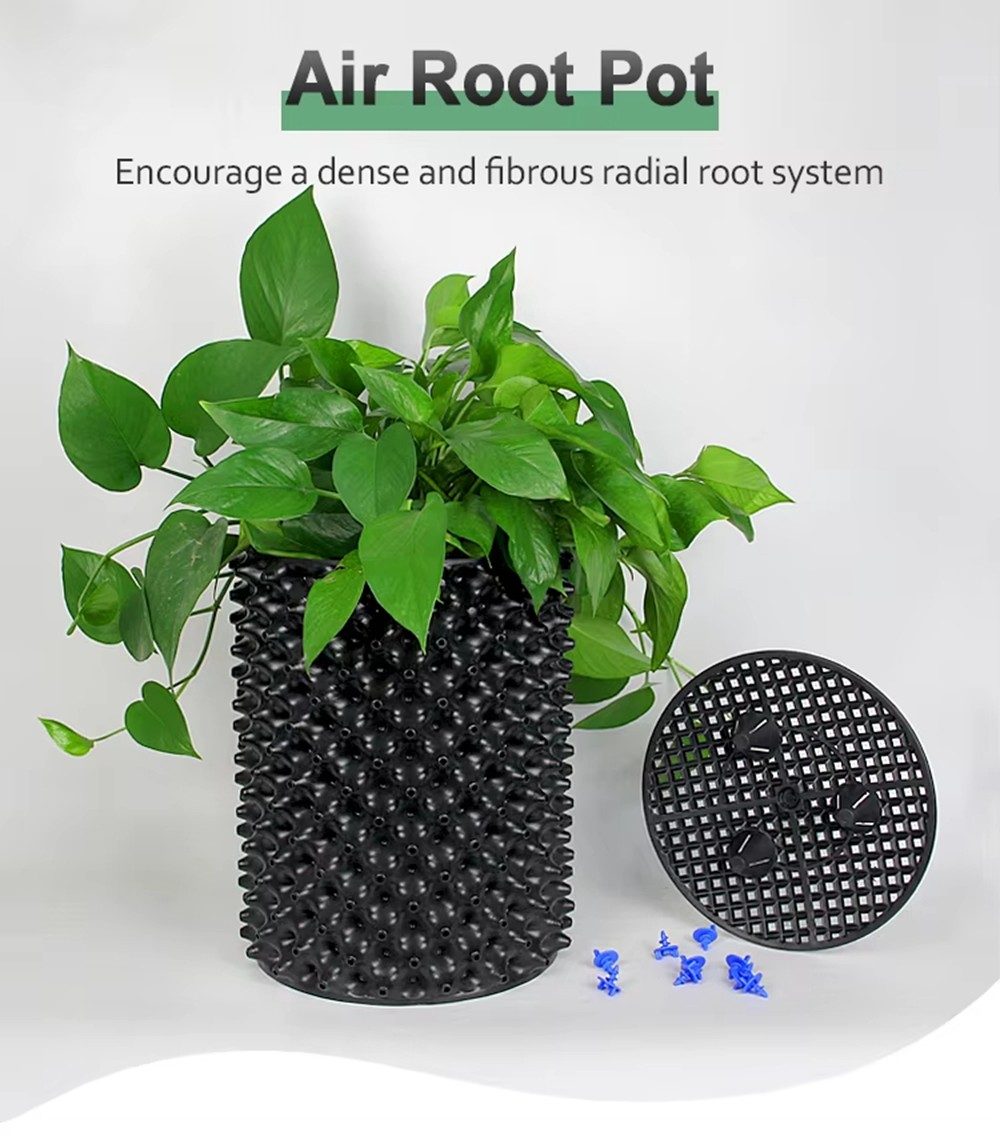
A pallet of root control pots looks the same whether the base is open or shut. Same black plastic, same pattern of holes, broadly the same price band. One of them prunes roots. The other lets the tap root coil into a small bowl at the bottom and quietly defeats the point of the product.
I open these things the way I open a sample of netting. Find the weak part first, then decide whether the rest is worth discussing.
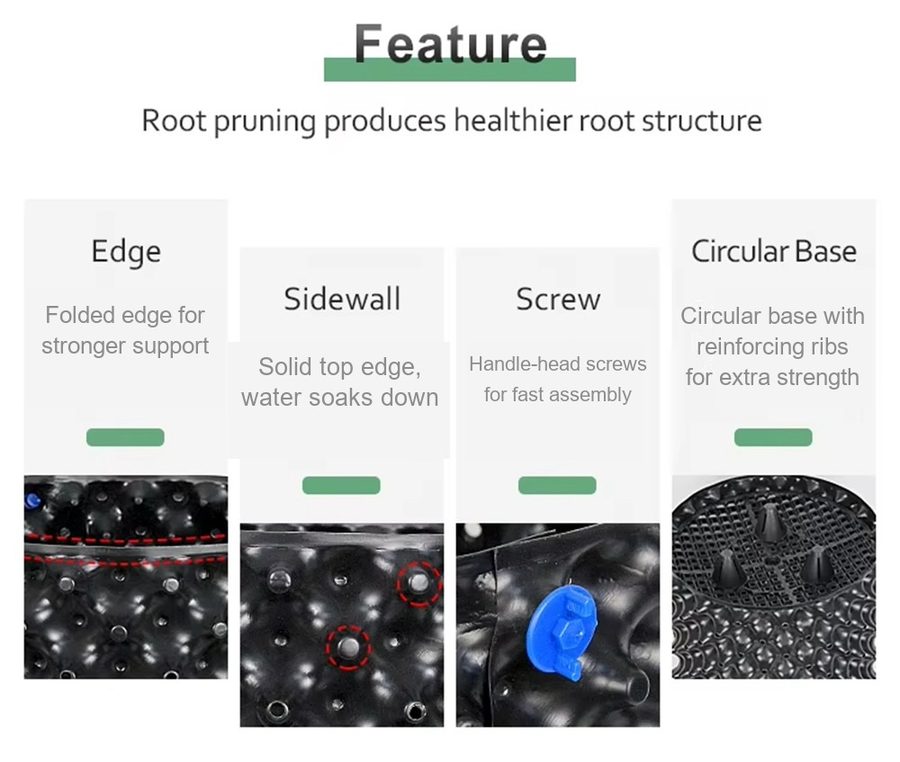
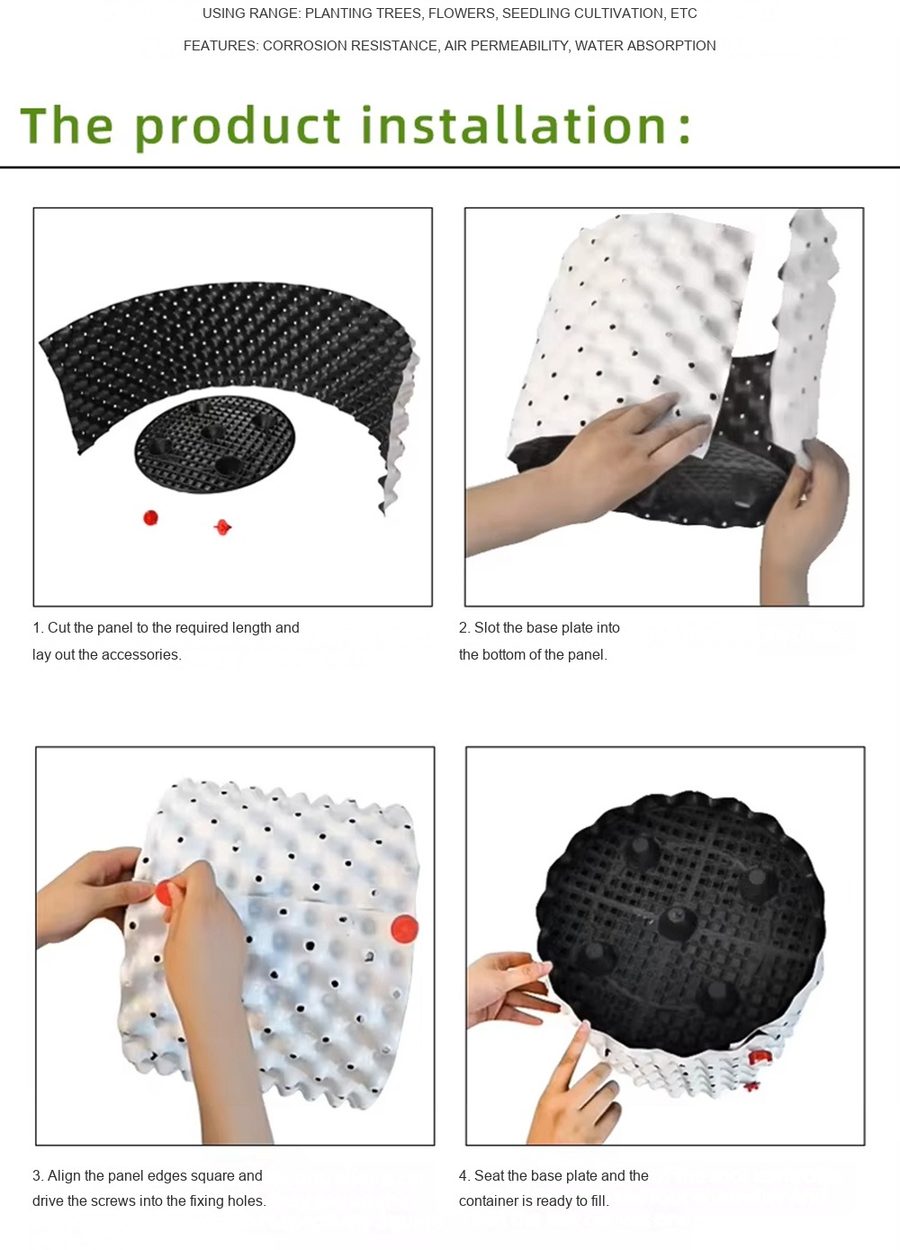
Four parts make up a container like this. A folded edge, a sidewall with holes, a couple of screws, and a base disc inside the roll.
Three of the four are hard to ruin. The edge holds a fold, the screws hold once, and a sidewall with holes in it will pass air. The base is where a pot with a good-looking sidewall still fails.
The reason is simple. The tap root grows down and hits the floor. If the floor has an opening, air stops the tip and the plant starts branching. If the floor has a solid centre cup, the tip sits in a dark pocket with nothing to stop it, and begins to turn. Give it a few weeks and you have a spiral.
From the outside you cannot see this. You catch it when the plant comes out, when the root ball leaves the pot as a disc with a knot in the middle and the sides barely colonised.
So before I look at anything else, I look down into the empty pot. Ribs and slots that run to the outer edge, and a centre that is open rather than closed. A closed bowl goes back on the pallet.
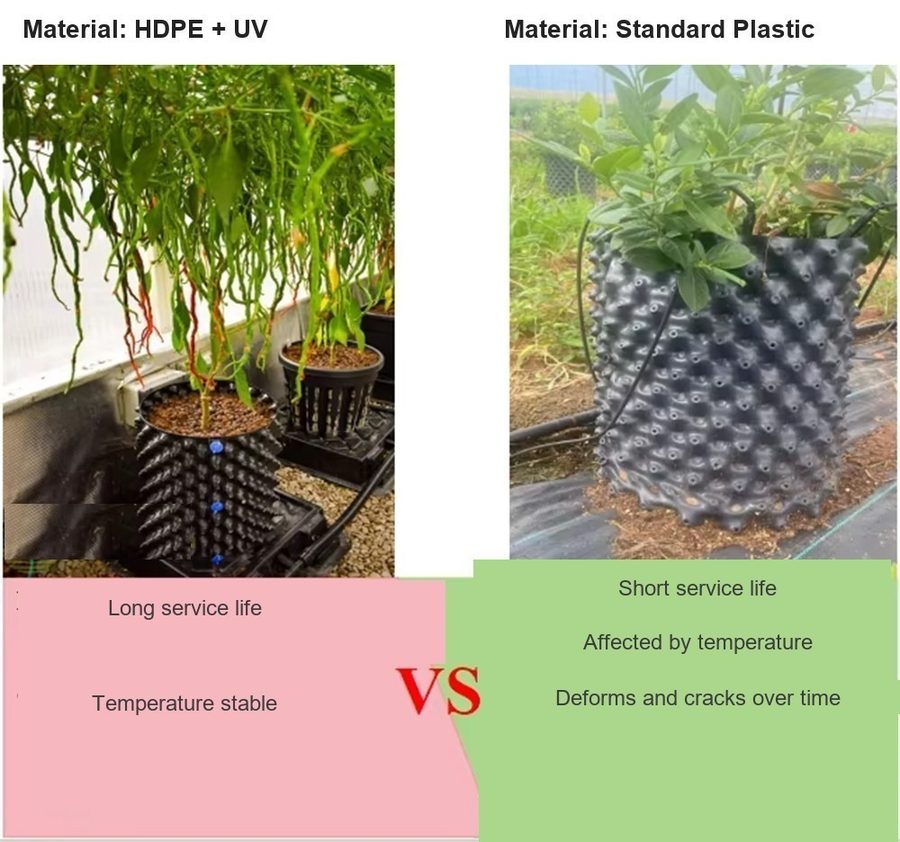
Two pots of the same black look can be different polymers, and that difference decides whether the thing survives two summers or ten.
High-density polyethylene keeps its impact strength outdoors. Rigid PVC does not. Under ultraviolet light it goes chalky, then brittle, and the fold is the first place to split, because that is where the stress lands every time the pot is opened and closed.
Ask what the polymer is by name. Then ask what UV stabiliser is in it, and at what loading. "UV treated" with no figure behind it is a sentence, not a specification, and I have heard it applied to material with almost nothing in it.
Wall thickness is not a number worth arguing about in an email. It shows up in handling.
A wet pot is heavy. Every lift flexes a thin sidewall, and the flex works the screws and the fold. Damage accumulates at the joint, under the rim, where nobody inspects.
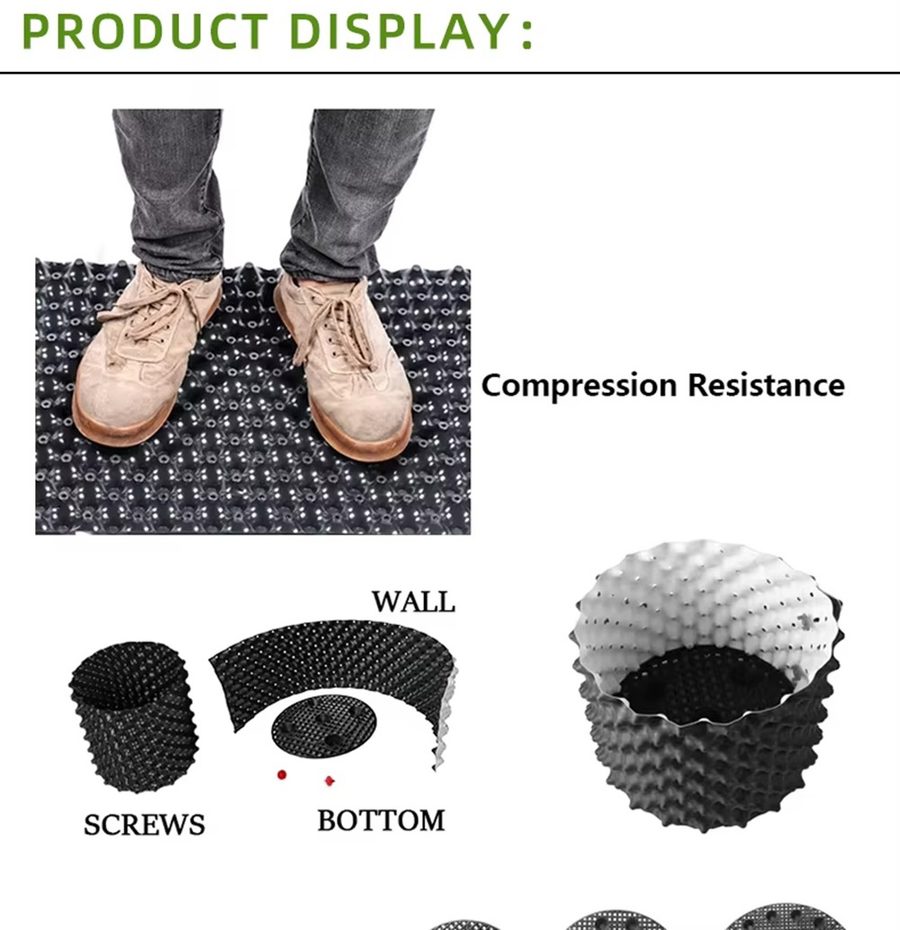
The test takes a second and needs no tools. Lay an empty sidewall panel flat and stand on it. A properly gauged panel takes an adult's weight and springs back. A thin one creases and keeps the crease. Our 1000 g/m² panels are specified to pass that, which is why we photograph the test instead of quoting a number and hoping.
The hole pattern is the working part of the pot, and two things get missed.
The first is coverage. The rows have to run all the way down. Most circling starts within the bottom quarter, and a pot whose perforations fade out near the base leaves a smooth band of plastic for a root to follow, like a handrail.
The second is the edge of each hole. A cleanly cut or moulded opening lets a root tip meet dry air and stop. A hole punched through molten plastic leaves a raised lip, and a lip can steer the tip sideways along the wall instead of out of it. It still usually prunes, but it is the weaker way to make a hole, and it snags on gloves and trolleys.
The sidewall joins itself along one line, and that line carries the hoop stress of the whole filled pot.
A straight butt joint leaves very little material in contact. An angled overlap gives the seam more to bear on and spreads the load round the fold. Both look finished once assembled, so open one up and look at the cut.
Then look at the screw. A screw with ribs under the head holds tension. A plain thin shaft snaps the second time it is tightened, and a nursery with snapped screws ends up wiring pots together, which is the beginning of the end for that container.
Bigger is not better. A tall pot with a thin wall flexes more, dries at the surface faster, and gets too heavy to move by hand once it is wet. Half the containers I see chosen badly are not a volume problem, they are a handling problem.
Our standard heights run from 20 cm to 70 cm. Choose by the plant that goes out of the gate, and by whether the pot travels on a trolley, a pallet or a shoulder. Nurseries running large-farm programmes usually settle on two sizes and stop there. One handling routine beats a perfect match on every line.
Empty one pot after a full season and read it like a report.
Root tips at the wall, short and branched. No woody spiral at the base. The fold still flat, screws still tight, plastic still black rather than grey. If you get a dense disc with a curl in the middle, the base failed. That is not a plant problem, and no fertiliser will fix it.
Sichuan Zhifang Net Industry Co., Ltd. has been making root control containers and agricultural netting since 2011, from a plant of nearly 10,000 m² with more than 50 production lines. We supply growers in 32 countries, and every carton carries a ZF security label inside the pack. That label has settled more than one argument about whether a shipment was ours, five years after it was made. Rose propagators in Yunnan using our containers report markedly better strike rates than they got from conventional pots, which is the same mechanism working in a different crop. Root control containers are built for 20 years and beyond in normal nursery use, and our horticultural netting carries a guaranteed UV stabilisation of 500 kly.
A normal pot has a closed wall and a closed floor, so a root that arrives at either one turns and keeps going along it. An air pruning pot has openings, the tip meets dry air, and the plant builds lateral roots behind it instead.
For outdoor use, that is what I would buy. PVC containers can hold up indoors for a season, but they lose impact strength in ultraviolet light and split at the fold. Before you order, it is worth looking at the full container range against the sizes you actually ship.
At the base, and it is almost always the same shape of failure. A closed centre cup looks tidy in a mould and allows the tap root to circle, which is the one thing the container exists to prevent. If you want the longer explanation, this page covers it.


