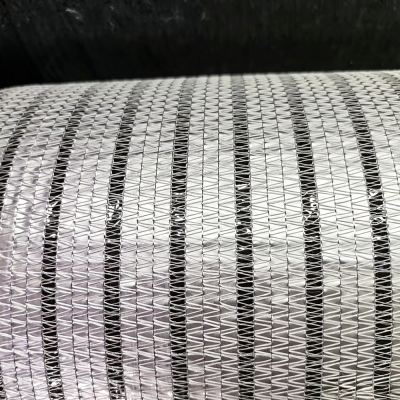


Raschel knitting is a warp knit, which means the loops are formed along the length of the fabric and linked to each other rather than to a weft yarn running across it. That single difference is why a knitted net does not unravel from a cut edge and does not distort diagonally under load: if one loop breaks, the ones around it hold. On a bale net the practical effect is a mesh that keeps its geometry while it is being pulled off the roll and wrapped under tension, rather than stretching into a diamond and leaving a gap at the shoulder. The yarn is white HDPE with UV stabiliser, knitted at 8.33 or 10 gsm.
Bale net is described by its weight and its width, and both of those can be met by more than one way of making the mesh. The construction is the part that decides how the net behaves when it is pulled off the roll under tension, and it is worth knowing which one is being quoted.
Raschel knitting is a warp knit: the loops are formed along the length of the fabric and linked to one another, rather than to a weft yarn running across. Two things follow from that, and both matter on a bale. A knitted net does not unravel from a cut edge, because there is no single yarn that can be pulled out and run; and it resists diagonal distortion, because a broken loop is held by the loops either side of it instead of letting the mesh open up. In practice a mesh that keeps its geometry wraps the same way every time and holds the shoulder of the bale instead of stretching into a diamond and leaving a gap right where the rain gets in.
The net is used on hay, silage and straw bales across the baler models in common use, and it is supplied in the widths those machines take rather than in a fixed few. The white colour is the standard for the same reason it is standard on most agricultural netting: it reflects rather than absorbs, and it makes a bale easy to see in a stack. More on how netting fits into a bale handling setup is covered under bale net wrap, alongside the shade net and planting bag ranges that go to the same farms.
| Material | White HDPE with UV stabiliser, raschel knitted |
| Net weight | 8.33 g/m2 or 10 g/m2 |
| Net width | 1 m, 1.22 m, 1.23 m, 1.62 m, 1.7 m, or to your requirement |
| Roll length | 2000 m, 2134 m, 2500 m, 3000 m, or to your requirement |
| Tension | 35 to 43 N at 8.33 g, 43 to 55 N at 10 g |
| Colour | White |
| Packing | Rolls on cardboard tubes, 16 or 12 rolls per pallet |
| MOQ | 2 tons |
The yarn is HDPE and carries a UV stabiliser, which is what lets a bale stay netted in a stack through a summer without the mesh going brittle at the folds. The colour is part of the same requirement: white mesh reflects rather than absorbs, so the net runs cooler on the surface of the bale than a dark net would, and it stays visible in a stack, which matters when bales are being picked out of a line. Tension runs from 35 to 43 N at 8.33 gsm and 43 to 55 N at 10 gsm, and the heavier net is the one to specify where bales are stacked high or handled more than once.
Widths run from 1 m to 1.7 m and roll lengths from 2000 m to 3000 m, with the narrower Japanese sizes and the 3600 m European rolls made to order. Rolls are packed on cardboard tubes, 16 or 12 to a pallet, and a 20 ft container takes around 190 to 210 rolls against 490 to 510 in a 40 ft high cube; capacity is 400 tons a month and delivery is about 15 days from deposit. Tell us the baler, the width, the crop and the quantity, and we will confirm the weight and the roll length. Buyers tracking what is going into hay, silage and straw operations can follow trade coverage such as HortiDaily and FreshPlaza for what growers are installing.
What does raschel knitted mean?
The mesh is warp knitted, so the loops interlock along the fabric rather than locking onto a weft yarn. That is why it does not unravel from a cut edge and does not distort diagonally under load.
Does a knitted net stretch into a diamond shape?
That is the failure mode of a woven mesh under tension. A raschel knit holds its geometry instead, which is what keeps the shoulder of the bale covered.
Why is the net white?
White reflects rather than absorbs, so it runs cooler on the bale surface, and it stays visible in a stack. Other colours are available to order.
Tell us the baler, the width, the crop and the quantity, and we will confirm the specification, the sample and the packing that suit your order.
Mark Wu, Co-founder & Technical Director, Sichuan Zhifang Net Industry. 15 years manufacturing agricultural nettings for growers in 32 countries.