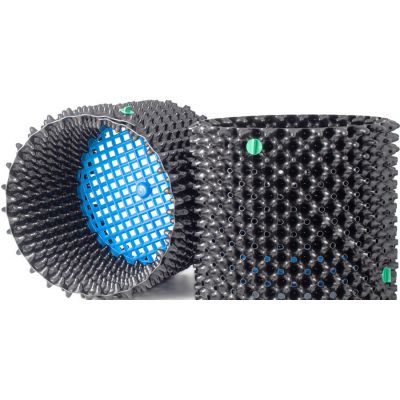


A root controller earns its name at the wall. Slotted sidewalls let root tips meet air as they arrive, which stops the spiral that costs a seedling its first season and pushes the plant into lateral, fibrous growth instead. That fibrous mass is what carries a seedling through transplant without stalling, and it is why the same pot turns out faster, more even batches. The body is moulded from UV stabilised PP/PE that shrugs off cracking and warping, so a nursery replaces fewer containers each season. The stackable build also nests down to roughly half the storage space of rigid rounds, which matters in a seed store.
Slotted walls make a root controller work, and the slot pattern decides how well. The openings in this pot are cut to let root tips reach air as they grow outward, so instead of turning along the wall the tip stops and branches. The seedling ends up with a fibrous root mass it can transplant without a check, and the nursery gets faster, more uniform batches out of the same bench space.

Every root tip that meets a smooth surface gets turned, and a turned tip keeps turning: that is how circling roots start. A slotted wall interrupts the cycle at the first contact. The exposed tip loses moisture to the air, growth stops at that point, and the plant responds by pushing new lateral roots into the medium. The result is a dense, self-supporting root ball rather than a coil, and dense root balls survive transplant without the stall that costs weeks. The same wall geometry runs through every size in the air pruning pot range, so a grower can step sizes up without changing how the roots are trained.

Seedling lines are the first use: after the germination and seedling tray stage, liners move here to build the root mass they will be sold on. Forest and amenity nurseries run the same pot for stock that is lined out or planted from the container. Fruit and ornamental growers use the larger rounds for young trees and shrubs, where an air-pruned root ball establishes faster and needs less aftercare in the first season. Because the pots stack when empty and stay rigid when filled, a mixed programme fits the same shelf and the same bench.

| Use | Nursery seedling propagation and growing on |
| Material | PP/PE, UV stabilised |
| Diameter | 20-70 cm |
| Height | 20-70 cm |
| Thickness | 0.6-1.2 mm |
| Colour | Black |
| Base plate | 20-60 cm |
| Samples | Available |

Empty pots nest flat and stack tight, which trims the storage footprint to roughly half of what rigid rounds take up over a winter. The body is moulded from UV stabilised PP/PE: it resists the cracking and warping that shorten container life, so the replacement list stays short and the same pot comes back for the next batch. Fixings are standard across sizes, and a damaged wall section is replaced as a single part. Growers who prefer a flexible field container can pair the pots with the planting bag range on the same programme.

Diameters and heights run 20 to 70 cm, and base plates cover 20 to 60 cm so a programme can standardise on one system from liner to field-ready stock. Panels ship flat and stack tight for freight, packing runs to your own label, and samples let you check the slot pattern against your own growing mix before a bulk order. Nursery practice and propagation trials are covered in the field by HortiDaily and FreshPlaza.
Does stacking the pots damage them?
No. Nesting is part of the design: empty pots stack into each other without loading the walls, and the PP/PE compound keeps the rim stiff so the stack holds its shape in storage.
How long do the pots last in a working nursery?
The UV stabilised body resists cracking and warping through sun, frost and washdown, so pots are normally reused across seasons rather than replaced every year.
What makes roots grow faster in these pots?
The slotted wall keeps interrupting root tips, and the plant answers with more lateral roots. A fibrous root mass intercepts more water and nutrients, which is what shows up as faster growth above the pot.
Send the sizes and quantities your nursery programme runs, and we will come back with the packing plan and lead time.
Mark Wu, Co-founder & Technical Director, Sichuan Zhifang Net Industry. 15 years manufacturing agricultural nettings for growers in 32 countries.