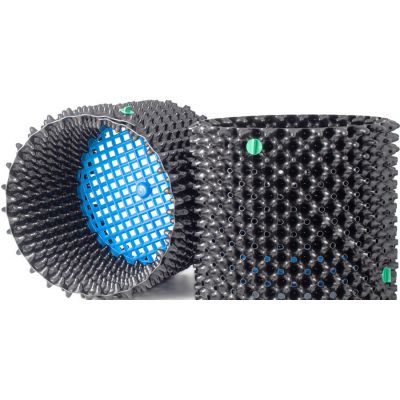


A tree container only earns its keep if it can be serviced and scaled, and this one is built that way. The studded wall comes as panels that lock together with screws; the base is a separate plate in six diameters, so a programme changes the pot by changing its parts. Root tips meet air at the wall openings and stop, which keeps the root ball fibrous instead of coiled, and stock moves up the size ladder without changing system. Diameters run 15 to 200 cm in PE or PVC from 0.6 to 1.5 mm, with colours on request and samples for testing.
A tree container has two jobs: hold the root ball outdoors, and stay serviceable when a programme changes. This one is built from three parts that do both: studded panels, lock screws and a base plate, with diameters running from 15 to 200 cm.

The wall comes as studded panels that lock together with screws, and the base is a separate plate, so a pot is assembled where it is needed and the seam stays reachable after planting. The studded face does the root work: every opening is a place where a tip meets air and stops, and the panel seam and the base are the two points a crew actually touches. Base plates come in six diameters and the wall in a range of heights, so one system carries everything from a liner round to a large tree container, and panels stack flat for freight.


Maple rows, shelter lines and general tree stock start small and end large, and this system follows the whole climb: 20 cm rounds take the first potting, 30 and 40 cm carry the growing-on sizes, and the large formats hold field-ready specimens. Because the pot scales by part rather than by model, a nursery keeps one wall system across the block, and roots lifted at any size come out fibrous rather than coiled. The same wall runs across the air pruning pot range.


| Use | Tree and nursery programmes, open-ground rows |
| Material | PE, PVC |
| Diameter | 15-200 cm, or customised |
| Height | 15-60 cm, or customised |
| Thickness | 0.6-1.5 mm |
| Base diameter | 15-60 cm |
| Colour | Black, white, or customised |
| Samples | Available |

Base plates run 15, 20, 30, 40, 50 and 60 cm. Each carries the studded grid, so water passes through and the underside of the root ball gets air even when pots stand straight on an open bed. On lifting day the pot travels with the tree, and the seam gives the crew a clean point to open when a root ball needs checking. The largest tree formats sit at the top of the range covered in the tree and nursery container range.

Black is standard, with white and matched colours on programme orders, so rows read consistently on site. Panels, plates and pots combine freely in one load, packed in woven bag or carton, and samples let a buyer test a plate against the position before committing a season. For flexible soft containers in the same family, the planting bag range covers growing. Trade coverage of production practice runs at HortiDaily and FreshPlaza.
How does the pot go together?
Studded panels lock with screws onto a base plate. Panels ship flat for freight, and a pot is assembled on site in the size the position needs.
What sizes suit a tree programme?
Diameters cover 15-200 cm with base plates from 15 to 60 cm, so one system carries liner rounds through to large tree containers, and custom sizes are accepted.
Can parts and colours be mixed in one order?
Yes. Black is standard, white and custom colours run on programme orders, and mixed loads ship with samples available.
Tell us the species, sizes and volumes your programme runs, and we will come back with the parts list, packing plan and lead time.
Mark Wu, Co-founder & Technical Director, Sichuan Zhifang Net Industry. 15 years manufacturing agricultural nettings for growers in 32 countries.