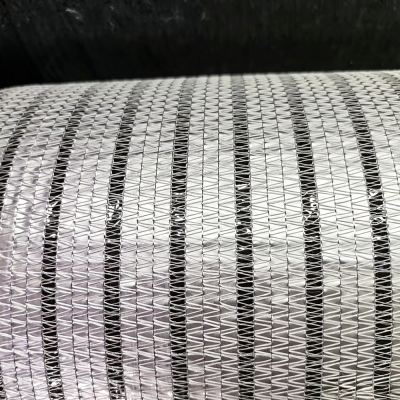


Bales with more moisture in them are the ones that punish the wrap, because a heavy haylage or baleage bale keeps pushing outward long after it has been rolled. This net is 100 per cent new HDPE, warp knitted so the mesh keeps its width and its tension under that load, holding 35 to 43 N at 8.33 gsm and 43 to 55 N at 10 gsm. The UV stabilization is in the yarn itself, not a coating, so rolls left on the baler and bales left in the open hold through a working season. The flat open mesh lets wrap film sit evenly on top, so film and net lift away together at feed out.
The bales that fail earliest are rarely the dry ones. Haylage and baleage carry more moisture, weigh more, and keep pushing outward against the wrap for hours after they are rolled, which is why the net on those bales has to hold tension rather than simply hold shape. This roll is built for that job, and the UV stabilization matters because a wet bale is also a bale that tends to sit outside longest.
A haylage bale is denser than a dry hay bale of the same size, so the net works against an outward load from the moment it is applied. That load is why tension is the number to check rather than thickness: the 8.33 gsm roll holds 35 to 43 N and suits hay, while the 10 gsm roll holds 43 to 55 N and is the one for haylage, baleage and dense straw. Both weights use the same warp knitted structure, which is what lets the roll hold its width across the full length instead of bedding in as it unwinds, so the wrap stays evenly pressed against the bale.
UV stabilization in the yarn, rather than a surface treatment, is what lets a roll sit on the baler through a working season without the outer layers going brittle, and it is what protects bales stored in the open before they are collected or fed. The effect shows up as colour and flexibility holding rather than fading and cracking after a few weeks of direct sun. For growers running both dry hay and silage, the bale net wrap range sits alongside the shade net and planting bag ranges that go to the same farms.
| Material | 100% new HDPE, warp knitted |
| Weight | 8.33 g/m2 or 10 g/m2 |
| Tension | 8.33 g: 35-43 N | 10 g: 43-55 N |
| Net Width | 1 m, 1.22 m, 1.23 m, 1.62 m, 1.7 m or by requirement |
| Roll Length | 2000 m, 2134 m, 2500 m, 3000 m or by requirement |
| Colour | White |
| UV Stabilization | In the yarn, holds through a working season |
| Packing | Rolls on cardboard tubes, 16 or 12 rolls per pallet |
On high moisture bales the net and the film work as one covering rather than two. The net holds the bale and gives the film a flat surface to sit on, and because the mesh is open and lay flat there are no ridges for the film to bridge over. At feed out the two lift away together as a single unit, which is what keeps the job quick when a bale is opened in front of the stock. Roll width is set by the baler: North American machines commonly take 48 or 51 inch rolls in 9840 feet or 64 and 67 inch rolls in 7000 and 8000 feet, while metric machines take 1.22 m or 1.23 m by 3000 m. Delivery runs about 15 days after deposit.
Rolls ship on cardboard tubes, 16 or 12 to a pallet, giving 190 to 210 rolls in a 20 ft container and 490 to 510 in a 40 HQ. Minimum order is 2 tons, delivery is about 15 days after deposit, and capacity runs at 400 tons a month, so orders for a silage season can be scheduled rather than queued. When costing a season, work from the number of bales: at two to three turns per bale, a 3000 m roll gives a predictable count once the bale diameter is fixed. Trade coverage of how growers handle high moisture bales, such as HortiDaily and FreshPlaza, is worth following if you are specifying for a mixed farm.
Is this net suitable for haylage and baleage, or only dry hay?
It covers both. Use the 8.33 gsm roll at 35 to 43 N for dry hay and the 10 gsm roll at 43 to 55 N for haylage, baleage and dense straw, where the bale is heavier and keeps pushing outward against the wrap. Tell us the crop and the moisture and we will confirm the weight.
Does the UV stabilization wear off?
No. It is part of the yarn rather than a coating on the surface, so it does not rub away as the roll turns on the baler. That matters most for rolls that stay on the machine through a season and for bales left in the open before collection.
Can the net be used together with wrap film?
Yes, and on high moisture bales that is the normal pairing. The net holds the bale and gives a flat surface for the film, and at feed out the film and net are removed together as one unit. Tell us your baler width and we will confirm the roll that matches.
Tell us the crop, how wet the bales are and the baler width, and we will confirm the weight, the roll and the packing that suit your order.
Mark Wu, Co-founder & Technical Director, Sichuan Zhifang Net Industry. 15 years manufacturing agricultural nettings for growers in 32 countries.