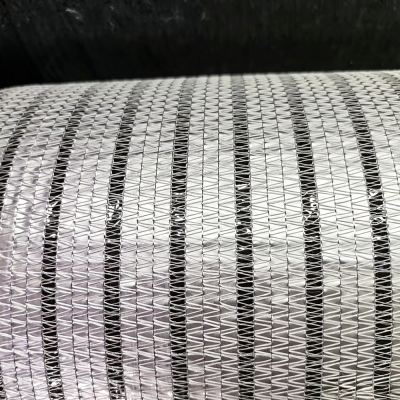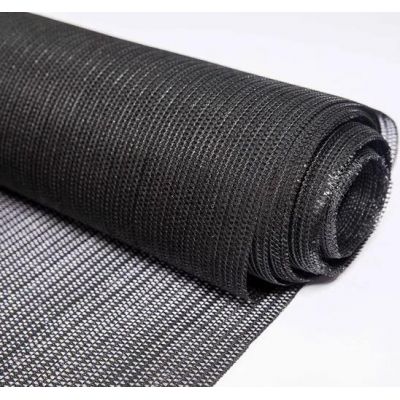


How many turns of net a baler takes to cover a bale is not a detail, because it sets the cycle time of the machine. A net that covers the bale in two or three revolutions lets the baler eject and move on sooner, and on a contractor running thousands of bales a season that difference accumulates across the day. It also uses less net per bale, which shows up on the consumable line rather than anywhere visible. The mesh here is bi-oriented, stretched in both directions rather than one, which is what gives it the strength to hold at those turn counts and to stay on the bale through handling and outdoor stacking.
Net wrap is bought as a consumable, so it is compared on price per roll. What that comparison misses is how many turns the net takes to cover a bale, because that number sets both the net used per bale and the time the baler spends on each one.
The mesh here covers a round or square bale in two to three revolutions. Fewer turns means less net per bale, which is the visible saving, and it also means the baler reaches the ejection point sooner, which is the saving that does not show on an invoice but does show in how many bales go through in a day. On a contractor running several thousand bales the second effect is usually the larger of the two. Holding a bale at that turn count is what the bi-oriented mesh is for: the net is stretched in both directions rather than one, so it resists tearing in the direction the bale pushes it and keeps its grip on the surface rather than sliding.
The net is used on dry hay and on silage bales, and buyers are usually contractors working several farms, dairy and beef operations doing their own baling, and hay traders who net and resell. Those buyers order by the pallet or by the container rather than by the roll, so the container loading figures and the monthly production capacity matter as much as the net itself. UV resistance is the other requirement on the list, because bales that are netted and stacked outdoors sit in the sun for months. More on how netting fits into a bale handling setup is covered under bale net wrap, alongside the shade net and planting bag ranges that go to the same farms.
| Material | 100% virgin PP, bi-oriented open mesh |
| Net weight | 8.33 g/m2 or 10 g/m2 |
| Net width | 1 m, 1.22 m, 1.23 m, 1.62 m, 1.7 m, or to your requirement |
| Roll length | 2000 m, 2134 m, 2500 m, 3000 m, or to your requirement |
| Tension | 35 to 43 N at 8.33 g, 43 to 55 N at 10 g |
| Packing | Rolls on cardboard tubes, 16 or 12 rolls per pallet |
| Supply capacity | 400 tons per month |
| MOQ | 2 tons |
Biaxial stretching pulls the mesh in two directions as it is made, which aligns the polymer along both axes instead of one. In practice that means the net resists a tear opening from a nick, and it holds its tension on the bale instead of relaxing once it is wrapped, which is what keeps the edge of the bale covered. UV resistance is the second half of the same requirement: a bale netted and left in a stack through a summer takes months of direct sun, and a net without UV stabiliser goes brittle at the fold lines and lets go first at the bale edge, which is exactly where the weather gets in. Colour is normally white, with red and black run to order.
Standard widths run from 1 m to 1.7 m and roll lengths from 2000 m to 3000 m, with the narrower Japanese sizes and the 3600 m European rolls made to order. Colour is specified with the order. Rolls are packed on cardboard tubes, 16 or 12 to a pallet, and a 20 ft container takes around 190 to 210 rolls against 490 to 510 in a 40 ft high cube; production capacity is 400 tons a month, which matters on a contract that has to be delivered in one season. Tell us the baler, the net width, the bale size and the annual volume, and we will confirm the specification. Buyers tracking what is going into hay and silage operations can follow trade coverage such as HortiDaily and FreshPlaza for what growers are installing.
How many turns does the net take per bale?
Two to three revolutions for a round or square bale, which is fewer than a standard mesh and is what shortens the baler cycle. Tell us your bale size and we will confirm the roll length you need.
What does bi-oriented mean on a net?
The mesh is stretched in both directions during production rather than one, so it resists tearing and holds its tension on the bale instead of relaxing after wrapping. Tell us how the bales are stored.
Will the net stand up to outdoor storage?
It is UV resistant, which is what keeps it from going brittle at the folds on bales left in the sun through a summer. Tell us the storage period and we will advise on the weight.
Tell us the baler, the net width, the bale size and the annual volume, and whether the bales are stored outdoors, and we will confirm the specification, the sample and the packing that suit your order.
Mark Wu, Co-founder & Technical Director, Sichuan Zhifang Net Industry. 15 years manufacturing agricultural nettings for growers in 32 countries.