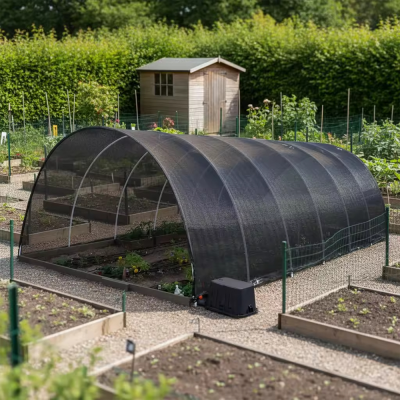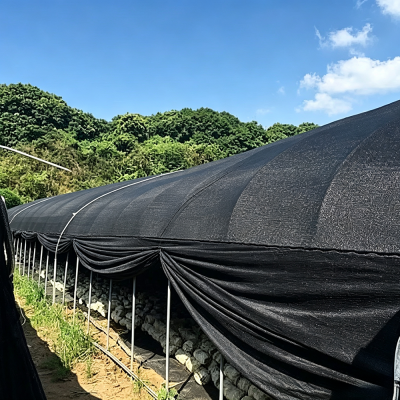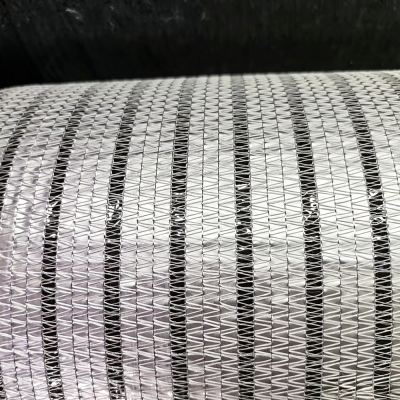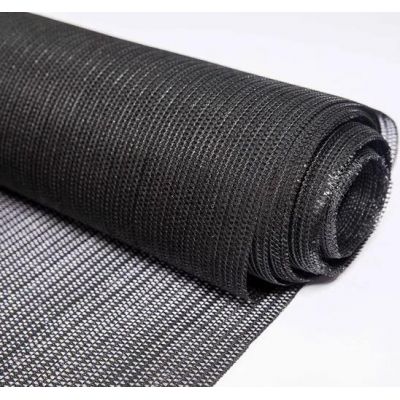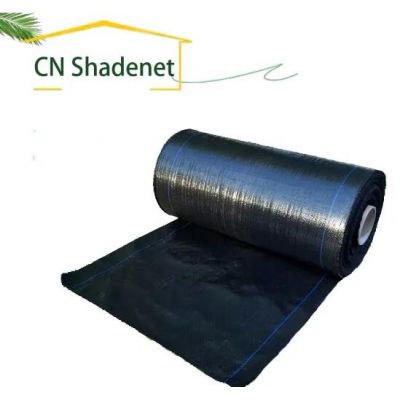


A roll of this net usually ends up doing two jobs. The main length goes over the frames, hoops or greenhouse openings as a row cover, and the offcuts and narrow strips go onto the fruit itself, tied around individual cucumbers, tomatoes or mangoes to keep the insects off the skin right up to harvest. That is why the UV stabiliser in the yarn matters more than it first appears: the same cloth is asked to survive a season on a frame and a season tied to a branch. The mesh is 40 x 25 in HDPE, supplied white or transparent as standard and cut to the length you need.
Most netting is bought for one job. This roll tends to get used for two. The bulk of it goes onto frames and hoops as a row cover; the narrow strips left over go around individual fruit, tied in place to keep the insects off the skin until it is picked. Both uses are in the photograph, and both are the reason the cloth is specified the way it is.
Covering a row and bagging a fruit are the same problem at two scales: keep the insect off the part of the plant being sold. A row cover does it for the crop in bulk, and a bag does it for the fruit that is worth the most per unit, which is why the second job is common on cucumbers, tomatoes and tree fruit. Doing both from one roll is a cost argument as much as a practical one: the wide cloth is cut to the frame, and what is left over is cut into strips for the fruit rather than thrown away. Working from one roll also means one specification to keep in stock, and one supplier to hold to it.
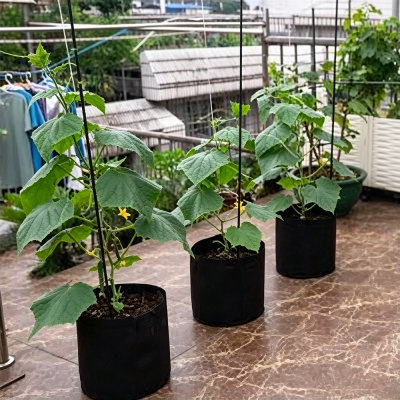
The wide cloth covers hooped rows, low tunnels and greenhouse vents and openings, and the strips go onto fruit on the plant. Colour is a light decision rather than an insect one, and it makes more difference on a row cover over growing plants than on a bag around a single fruit, where very little of the photosynthesis is happening. White or transparent is the standard specification, with other shades available on request. Growers raising stock under the same netting often order a planting bag beside it, and the wider shade net range covers the grades where the crop needs shade rather than insect exclusion.
| Material | HDPE with UV stabilised yarn |
| Mesh | 40 x 25 as standard, other counts to order |
| Weight | 80 to 130 gsm |
| Width | Up to 5 m |
| Roll length | 30 m, 50 m and 100 m |
| Colour | White or transparent, other shades on request |
| Working life | 5 years |
| MOQ | 5000 m2 |
A row cover spends the season in the sun, and a fruit bag spends the season tied to a branch, which is a harder life than it sounds: the cloth is stretched over the fruit, it rubs on the stem, and it is the first thing the sun reaches when the leaves move. A net without UV protection in the yarn breaks down at the fold lines and the bag fails while the fruit is still on the tree. The stabiliser is worked into the HDPE rather than applied on top, so the protection does not wash or wear off the surface. Where the requirement is a shade rate rather than insect exclusion, a knitted monofilament net is the better fit.
Mesh count, weight, width, roll length and colour are made to order, and the standard minimum order quantity is 5000 m2. Rolls ship in one strong polybag with a label, in 30 m, 50 m and 100 m lengths as the usual options. If you are buying for both jobs, tell us the row spans and the fruit you are bagging, because the strip width for bagging is cut from the same roll and it is worth planning the widths together. Buyers tracking what is going into vegetable and orchard cropping can follow trade coverage such as HortiDaily and FreshPlaza for what growers are installing.
Can the same net be used as a row cover and as a fruit bag?
Yes, and that is how most buyers use it. The roll is cut to the frame for the row cover and the remaining cloth is cut into strips for the fruit. Tell us both spans and we will confirm the widths.
How long will the net last tied around fruit?
The working life we quote is five years, and the limitation in a bagging job is the friction at the tie rather than the sun. If the tie point is what worries you, tell us and we will advise on the weight that suits it.
Do you supply it in other colours?
White and transparent are the standard specifications. Other shades are available on request, and the colour is a light decision rather than an insect one. Tell us what you are covering and we will advise.
Tell us the row spans, the fruit you are bagging and the mesh count you have in mind, and we will confirm the widths, the roll sizes and the packing that suit your order.
Mark Wu, Co-founder & Technical Director, Sichuan Zhifang Net Industry. 15 years manufacturing agricultural nettings for growers in 32 countries.