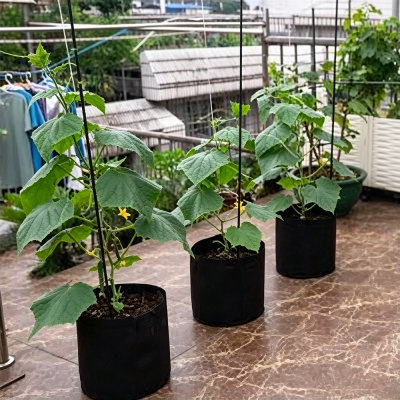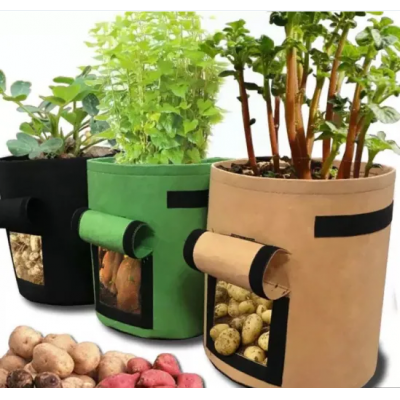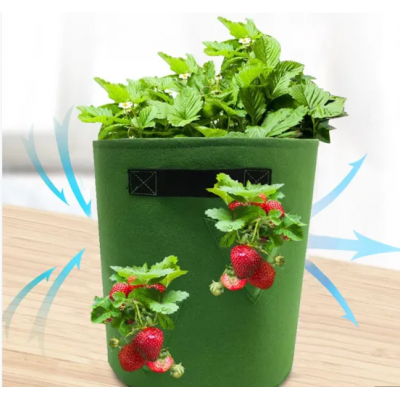


On a propagation bench the cost that matters is labour per seedling, and most of it sits in one movement: taking the plant out of its container. Lifting a root ball out, keeping the medium on it, and setting it into the next pot takes a person several seconds each, and if the ball breaks the plant pauses while it re-establishes. A bag that goes into the ground or into the larger pot with the plant still in it removes that movement entirely, and the medium stays round the roots because nothing was lifted. When the tray above it is emptied, the fabric bag is still good for the next propagation cycle.
Propagation is the part of a growing operation where the numbers are largest and the margins are thinnest, because it is done thousands of times rather than hundreds. Small savings per seedling are what move the cost of a bench, and the largest single saving is often a movement that is simply unnecessary.
Taking a seedling out of its container is slow work done carefully. The plant has to be supported while the pot is tipped, the medium has to stay on the roots, and if it does not the seedling sits still for a week or two while it recovers. A fabric bag can be planted whole, so the movement disappears, the root ball is never exposed, and the seedling starts growing from the day it goes in rather than the week after. The saving is per plant and it is repeated across every plant on the bench, which is why it matters commercially even though it looks like a small convenience at the scale of one pot.
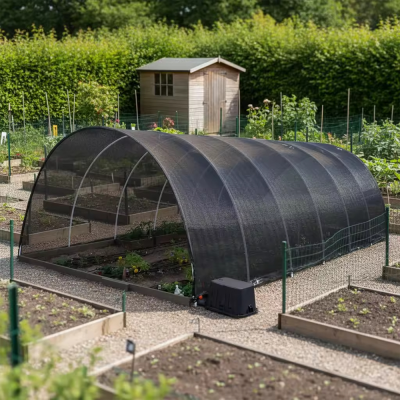
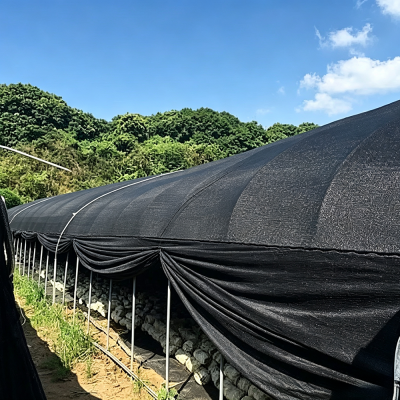
The bags are used on propagation benches indoors, in greenhouses where a bench is filled, grown on and emptied on a schedule, and in nurseries moving stock through several sizes. The fabric drains and holds moisture at the same time, so a seedling is not sitting either wet or dry, and the wall air prunes the roots that reach it. The seams are reinforced, which is what allows the bag to be lifted and moved while it is full rather than only handled when empty. Growers ordering for the same houses often add a planting bag for the growing-on stages, and where the stock also needs shade, the shade net range covers that separately.
| Model | GB-036 |
| Material | Non woven fabric, 300 gsm |
| Set | Grow bag supplied with matching seedling tray |
| Size | Made to order across the range |
| Seams | Double stitched, reinforced handles |
| Reuse | Bag reusable after the tray is emptied |
| Colour | Grey, terracotta, black, or to your requirement |
| Sample | Free sample available |
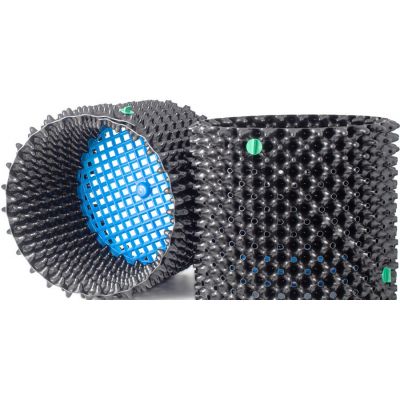
The tray and the bag do different jobs in the same run. The tray holds the propagation stage, where germination and the first weeks happen; the fabric bag holds the seedling that follows, and because it is fabric rather than rigid it can go into the ground or into the next size pot with the plant still inside. When the tray above it has been emptied, the bag is still sound and goes back onto the bench for the next propagation cycle, which is what keeps the plastic out of the waste stream. The 300 gsm fabric and the double stitched seams are what make that second cycle realistic. Where a round rigid container is wanted instead, a grow bag with air pruning seams is also available.
Sizes are made to order across the range, and the bag and tray are supplied as a set where both are needed. Colour, logo and handle configuration are set with the order, and a free sample is available so the fabric and the seams can be checked before a bulk run. The bags fold flat and stack in cartons, which keeps storage and freight down on a propagation order. Tell us the crop, the tray format, the size and the quantity, and we will confirm the specification. Buyers tracking what is going into propagation and nursery production can follow trade coverage such as HortiDaily and FreshPlaza for what growers are installing.
Does the bag really go into the ground with the plant?
Yes, the reinforced seams allow it to be planted whole, which is what removes the lifting step and keeps the root ball intact. Tell us the crop and the next stage.
Can the bag be used again after the tray is emptied?
It is made to go back onto the bench for the next propagation cycle, which is where the plastic saving comes from. Tell us how many cycles you need.
What fabric weight are the bags?
300 gsm with double stitched seams and reinforced handles, which is what allows a full bag to be lifted and reused. A free sample is available to check.
Tell us the crop, the tray format, the size and the quantity, and we will confirm the specification, the sample and the packing that suit your order.
Mark Wu, Co-founder & Technical Director, Sichuan Zhifang Net Industry. 15 years manufacturing agricultural nettings for growers in 32 countries.