

On a woody seedling there is one failure that the fabric wall alone does not fix. A root that meets a smooth surface turns and keeps turning, and on a tree that circling root is still circling years after planting, which is what girdling means and why it kills trees slowly. A copper treated fabric goes further: the copper at the wall stops the root tip chemically as well as physically, so the root does not merely stop but branches while it is still inside the container. For maple and oak seedlings that is the difference between a high proportion of saleable stock and a batch thinned by culled root systems.
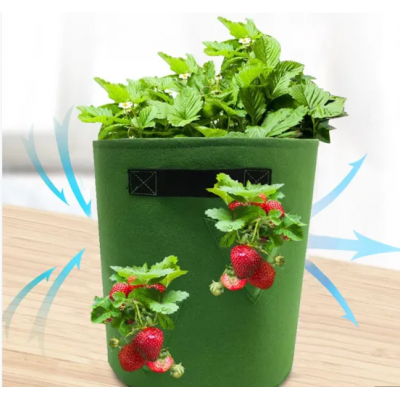
A fabric grow bag stops roots circling by letting air reach them at the wall. That works for a season crop and mostly works for a shrub. On a tree seedling there is a second problem that air pruning alone does not answer, and it is worth understanding before specifying a bag for woody stock.
Girdling is what happens when a root grows round the inside of a container and keeps going after the tree is planted. The ring tightens as the trunk thickens, and over years it strangles the tree from below, which is why a tree with a circling root can look healthy for a decade and then decline. A copper treated wall addresses it differently from a plain porous wall: the copper stops the root tip on contact, so the root responds by branching rather than simply halting. The result is a fibrous root system rather than a few long roots bent into a circle, and on maple and oak seedlings that shows up as a lower cull rate when the stock is graded.
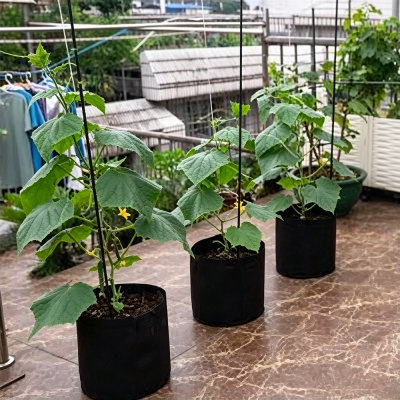
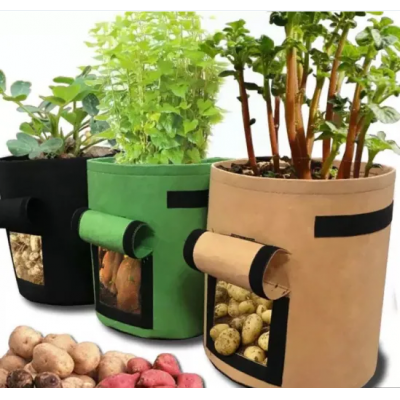
The bags are used in tree and hedging nurseries where the stock stands for more than one season, in propagation houses where seedlings are graded and moved, and on terraces and patios where a raised bed is not practical. The UV treated felt and the cross stitched seams are what allow the bag to take wet soil up to 15 gallons and still be lifted by the handles. Because the fabric breathes, a bag standing outdoors through a wet winter does not leave the roots in a saturated medium. Growers ordering for the same nursery often add a planting bag for smaller stock, and where the nursery also shades young plants, the shade net range covers that separately.
| Model | GB-030 |
| Material | UV treated felt, copper treated option available |
| Size | 10 to 50 cm diameter standard, other sizes to order |
| Colour | Black, green, or to your requirement |
| Seams | Reinforced cross stitching, holds wet soil to 15 gallon |
| Storage | Folds flat, 500 units per carton |
| Options | Custom diameter and handle attachment |
| Sample | Free sample available |
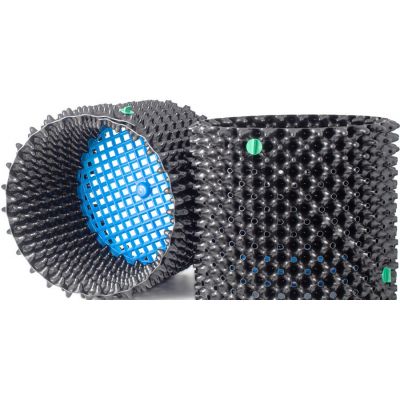
The two practical figures on this bag are what it will hold and how it packs. Wet soil up to 15 gallons is the load the cross stitched seams are rated for, and that is the point at which a bag is at its heaviest and most likely to be lifted; the reinforced handle attachment is what takes that load. The packing figure matters for a nursery ordering in volume: 500 units fold into a single carton, so a season’s worth of bags occupies a corner of the store rather than a bay, and the freight on an incoming order is a fraction of what rigid pots would cost. Where a round rigid container is wanted instead, a grow bag with air pruning seams is also available.
Standard diameters run from 10 to 50 cm, with other sizes and the copper treated option made to order. Colour, logo and handle attachments are set with the order, and a free sample is available so the fabric can be checked before a bulk run. Tell us the species, the bag diameter, whether the stock is woody and how long it stays in the bag, and we will confirm the specification. Buyers tracking what is going into tree nurseries and propagation can follow trade coverage such as HortiDaily and FreshPlaza for what growers are installing.
What does the copper treatment do?
It stops the root tip on contact rather than only deflecting it, so the root branches instead of circling. On woody stock that is what prevents girdling years after planting. Tell us the species and we will advise.
How much wet soil will the bag hold?
The seams are rated to 15 gallons of wet soil, which is the heaviest the bag will be when lifted. Tell us the bag size and how it is handled and we will confirm the specification.
How do the bags ship?
They fold flat, and 500 units fit in one carton. On a bulk order that is the largest single saving, because the volume and the freight both fall compared with rigid containers.
Tell us the species, the bag diameter, whether the stock is woody and how long it stays in the bag, and we will confirm the specification, the sample and the packing that suit your order.
Mark Wu, Co-founder & Technical Director, Sichuan Zhifang Net Industry. 15 years manufacturing agricultural nettings for growers in 32 countries.