

A farm that runs hay, silage and straw through the same baler does not want three different consumables in the shed. One warp knitted HDPE net, in two weights, covers all three: 8.33 gsm for dry hay handled gently, 10 gsm where the bale is dense and the baler runs tight. The open mesh lay-flat surface pushes stalks down against the bale so rain runs off rather than collecting in twine valleys, and the surface stays smooth enough that silage film comes off with the net as one unit. Roll lengths follow the market, from 2000 m to 3600 m, and width runs from 1 m to 1.7 m, so the roll arrives set up for the baler.
A baler does not care what crop is in front of it, and buying a separate consumable for each crop is where the shed starts filling up with part used rolls. One white warp knitted HDPE net, in two weights, is what most mixed farms settle on, and the reason is less about saving money on the roll than about not stopping the baler to swap stock.
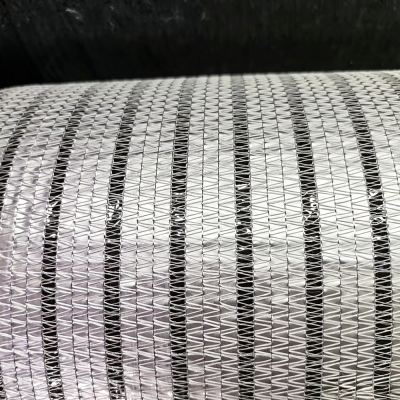
The net is 100 per cent new HDPE, warp knitted into an open mesh. On dry hay it is the 8.33 gsm roll that does the work, because a hay bale is handled comparatively gently and the job is to hold the surface smooth. On silage and on dense straw the 10 gsm roll takes over, because that bale is tighter, heavier and more likely to be moved by grab. The difference between the two weights shows up as tension rather than thickness: 8.33 gsm holds 35 to 43 N, while 10 gsm holds 43 to 55 N, so the heavier roll is the one that stays tight when the bale is dragged. Both weights use the same lay-flat mesh, which is what keeps rain running off the bale instead of collecting in the valleys between twine, and the same open structure means silage film lifts away with the net as a single unit at feed out.
Roll length is not a free choice, because the baler is set up for one width and one length and changing it means changing settings. That is why the net is supplied cut to the market it is going to: North American rolls run 1.23 by 3000 m, 1.62 by 2134 m and 1.71 by 2134 m; Japanese rolls run shorter and narrower at 0.75 by 1000 m or 0.90 by 2000 m; European rolls sit in between at 1.05 by 3600 m and 1.23 by 3600 m. Widths across the range are 1 m, 1.22 m, 1.23 m, 1.62 m and 1.7 m, and lengths run 2000 m, 2134 m, 2500 m and 3000 m, with intermediate lengths made to order. Farms running the same baler across hay and silage usually keep one width for both and let the net weight do the adjusting. Where bales move on to further handling under cover, the bale net wrap range sits alongside the shade net and planting bag ranges that go to the same farms.
| Material | 100% new HDPE, warp knitted |
| Weight | 8.33 g/m2 or 10 g/m2 |
| Tension | 8.33 g: 35-43 N | 10 g: 43-55 N |
| Net Width | 1 m, 1.22 m, 1.23 m, 1.62 m, 1.7 m or by requirement |
| Roll Length | 2000 m, 2134 m, 2500 m, 3000 m or by requirement |
| Colour | White |
| Function | Reduce weather related spoilage |
| Packing | Rolls on cardboard tubes, 16 or 12 rolls per pallet |
The same net is quoted two ways depending on where the buyer sits. North American buyers often see the roll as 48 or 51 inches wide by 9840 feet, or 64 and 67 inches by 7000 and 8000 feet, because that is how the baler manual reads. Metric buyers see the same rolls as 1.22 m or 1.23 m by 3000 m, and 1.62 m or 1.7 m by 2134 m. The two are the same product measured two ways, and it is worth agreeing on one convention before the order is placed so the roll that arrives matches the baler. The net cuts cleanly with a knife, which is also why a spare cutting blade or a dedicated cutter is worth ordering with the rolls rather than after. Delivery runs about 15 days after deposit, with T/T and L/C both accepted.
Rolls ship on cardboard tubes, 16 or 12 to a pallet, which gives 190 to 210 rolls in a 20 ft container and 490 to 510 in a 40 HQ. Minimum order is 2 tons, and supply capacity runs at 400 tons a month, so repeat orders can be scheduled rather than queued. Buyers planning a season should work from the bale count rather than the roll count: a bale takes two to three turns of net, so a 3000 m roll does a known number of bales once the bale diameter is fixed. Trade coverage of what growers are running, such as HortiDaily and FreshPlaza, is worth watching if you are specifying for a mixed farm.
Can the same net be used for hay and for silage?
Yes. The 8.33 gsm roll suits dry hay and the 10 gsm roll suits silage and dense straw, so a mixed farm keeps one width of roll and two weights rather than two completely separate products. Tell us the crops and we will confirm which weights to carry.
How do I match the inch label to the metric roll?
A 48 or 51 inch roll corresponds to 1.22 m or 1.23 m, and 64 or 67 inches corresponds to 1.62 m or 1.7 m. Tell us the baler model and the roll length in feet, and we will confirm the equivalent metric roll.
What is the minimum order and the lead time?
Minimum order is 2 tons, delivery is about 15 days after deposit, and capacity of 400 tons a month means seasonal orders can be scheduled in advance rather than queued behind other buyers.
Tell us the crops you bale, the baler width and the roll length in the unit your manual uses, and we will confirm the weight, the roll and the packing that suit your order.
Mark Wu, Co-founder & Technical Director, Sichuan Zhifang Net Industry. 15 years manufacturing agricultural nettings for growers in 32 countries.