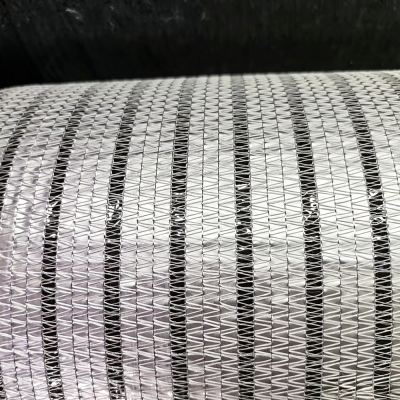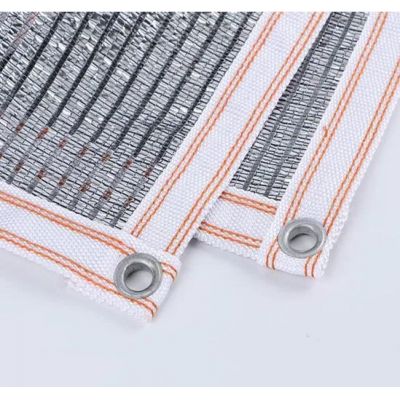


Growers who fit a reflective screen and then see no change in yield have usually solved the wrong problem. Shade rate says how much light is blocked; it says nothing about how much of that light still reaches the crop, or whether it arrives evenly. On an aluminet screen the aluminium foil strips alternate with clear film strips, so part of the light is reflected and part passes through as diffuse light rather than being stopped outright. Under a single span that shows up as brighter bands down the ridge and shadowed strips near the gutters, which is why we often ask for the roof drawing. Shade rate is 95 per cent, energy saving rate 30 per cent.
The screen goes up, the house is cooler, and the crop looks much the same as it did last season. When that happens the screen is not necessarily at fault. A shade percentage tells you how much light was kept out. It does not tell you how much arrived, or whether it arrived in the right places.
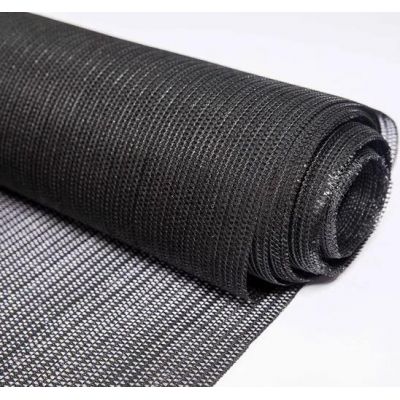
Two screens carrying the same 95 per cent shade rate can hand the crop quite different light. A black knitted net absorbs what it intercepts and re-radiates it as heat. A foil screen reflects a large share of it upward and sideways, and the strips that are not foil let a portion through in a scattered form. The second case leaves more usable light in the house at the same headline number.
This is the part that gets lost when screens are compared on price per roll. The number that decides the crop is the light the leaves actually receive, and the glasshouse literature makes the same point about diffuse light and canopy penetration. Reading the house before ordering matters more than picking a percentage off a list.
The construction is a knit of aluminium foil strips set beside transparent strips. Sunlight that meets the foil is reflected; sunlight that meets the clear strip passes through, and because the strip acts as a small aperture the light leaves it spread rather than in a beam. The mix of the two materials across the surface is what sets how much diffusion a given aluminet grade delivers.
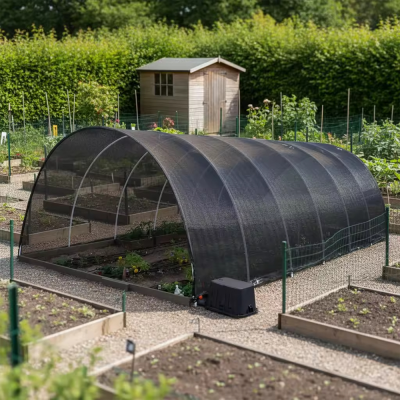
The distribution problem follows from the geometry of the house, not from the fabric. A single span across a ridge shades the ridge line hardest and leaves the gutters brighter than the middle. Panel layouts even that out and are the reason we ask for the roof drawing rather than just an area figure. On a house with a tall crop the upper leaves are also screened first, so a crop that runs to the roof is laid out differently from a low bench crop.
| Material | Aluminium foil strips laminated to transparent film strips |
| Structure | Knitted foil and clear strip construction |
| Shade rate | 95%, other rates made to order |
| Energy saving rate | 30% |
| Standard size | 4 x 3 m, other sizes to order |
| Guarantee | 500kly |
| Shrinkage | 1.5% |
| Flame retardant | Available to order on the same construction |
| Model | ASN-006 |
| Packing | PE bag, customised packing on request |
Four things change the answer more than the shade figure does. The roof shape sets where the shading falls. The crop height sets which leaves are screened. The glazing sets how much light arrives before the screen is even drawn. The vent layout sets whether the house can clear the humidity that a drawn screen holds down. Send those four and the shade rate follows from them.
Where a house runs both, the aluminet screen usually carries the bright weeks and a closed weave aluminet screen takes the tail of the season when the nights matter more than the surplus light. Both sit in the wider shade net range alongside plain knitted shade net for the houses that do not need reflection at all.
Diffusion is the property buyers ask about and the one that varies most between mills. Uneven strip widths or a laminate that lifts after a season both change it, and neither is visible in a sample photograph. Our screens go through the same five in-house checks as the rest of the range, ageing and tensile included, before a roll is packed.
We have been making agricultural netting since 2011, in a plant of close to 10,000 square metres with more than 50 machines. Protected cropping practice is covered by the trade press, including the coverage at greenhouse industry news and the management guidance at protected crop management. Company background sits on our about page.
Does a foil screen lower the light too much for the crop?
It keeps less light out than a black net at the same shade rate, because the clear strips pass a share of it through. If the crop is light hungry, tell us and we will quote a lower rate on the same construction.
Why do you ask for the roof drawing?
Because shading falls unevenly across a span. A single sheet over a ridge line darkens the ridge and leaves the gutters bright. With the drawing we can lay the panels out so the crop sees an even screen.
What does the 500kly guarantee refer to?
It is the ultraviolet energy the fabric is rated to take before it starts to degrade. Virgin imported and domestic raw material, UV and anti-ageing additives worked into the yarn, then a shaping treatment.
Can I order a screen for a bench crop rather than a full span?
Yes. Shorter drops are made for bench and gutter level, and widths and lengths are cut to the bay you send.
Send the roof drawing, the crop and its height, and we will confirm the shade rate and the panel layout that suit the house.
Mark Wu, Co-founder & Technical Director, Sichuan Zhifang Net Industry. 15 years manufacturing agricultural nettings for growers in 32 countries.
Running an aluminet screen on your house? Leave a review below and tell other growers how it changed the light under it.