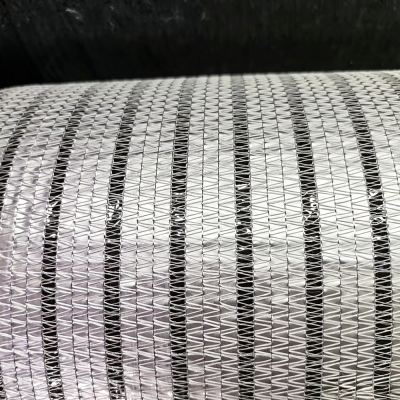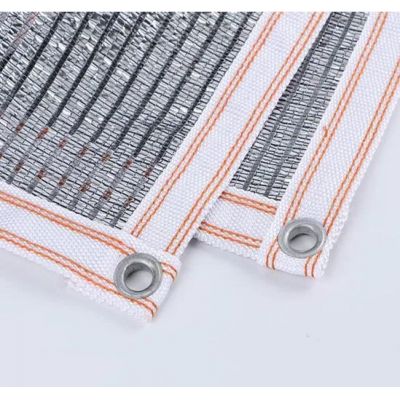


A closed weave screen is chosen when the house has to hold heat, not just block light, and the tightness of the knit decides that. Here the aluminium foil strips sit close together with only narrow openings between them, so less of the warmth collected under the roof escapes after sunset than it would through an open-hole net. The same tightness has a second effect buyers meet on the first hot afternoon: the screen restricts air movement as well as radiation, so humidity builds under it unless the house is ventilated around the draw period. Shade rate is 95 per cent, the energy saving rate is 30 per cent, and widths and lengths are cut to the bay you send.
The screen arrives, goes up over the crop, and holds the temperature where it was asked to. Two weeks later the grower is looking at condensation on the leaves and blaming the fabric. The fabric is doing what a closed weave is meant to do. The house is not set up for it.
Shade netting for greenhouses splits by how much of the surface is opened up. An open-hole knit leaves visible gaps between the yarns, and those gaps let air pass through the screen while it is drawn. A closed weave pulls the aluminium foil strips in tight, leaving only narrow slits, and the screen starts to behave more like a physical layer than a sieve.
That difference is not a quality ranking. It is a choice about which problem the house is being asked to solve. Where the summer peak is the enemy and ventilation is ample, the open net does the job with less restriction. Where the nights are the expensive part and the house is tight, the closed weave holds the warmth that the open net would let drift away.
The first effect is thermal. Warmth that collects under the roof during the day leaves through the cover after dark, and the rate it leaves at depends on how open the screen is. The closed weave on this model is rated at a 95 per cent shade rate and a 30 per cent energy saving rate, the retention figure being the point of the tighter knit.
The second effect is humidity, and it is the one that catches people out. Restrict airflow and the moisture released by the crop has fewer routes out. That is manageable, but it has to be managed: ventilate around the draw period rather than sealing the house through it, and where the crop cannot tolerate leaf wetness, leave the screen cracked open through the middle of the day. Growers moving from an open net to a closed screen should expect to revisit their vent settings in the first season.
The third effect is on light spread. A tight knit blocks more directly overhead, and in a house with a ridge the shading falls unevenly unless the screen is run in panels rather than as one span.
| Material | Aluminium foil laminated to a tight polyethylene knit |
| Structure | Closed weave, narrow slits between strips |
| Shade rate | 95%, other rates made to order |
| Energy saving rate | 30% |
| Standard size | 4 x 3 m, other sizes to order |
| Guarantee | 500kly |
| Shrinkage | 1.5% |
| Flame retardant | Available to order on the same construction |
| Model | ASN-008 |
| Packing | PE bag, customised packing on request |
Cold nights and clear days are the pattern a closed screen suits, because that is where the two effects line up: the screen protects the crop through the hottest hours and then holds the day’s heat into the night. Tomato and cucumber houses in temperate climates are the common case, along with cut flower crops that want light without the midday burn.
Where the house already runs an open reflective net, the closed weave is often added for the shoulder weeks rather than replacing it. A reflective aluminum foil shade net in an open knit carries the peak, and the tighter screen takes over as the season cools. Growers running both usually keep a spare aluminium foil thermal screen on the shelf for replacement panels. The full shade net range covers open and closed types.
Closed weave is the harder construction to hold consistent, because the gaps between strips have to stay even across the full roll. Uneven knit shows up as streak shading in the house long before the screen wears out. Our screens go through the same five in-house checks as the rest of the range, ageing and tensile included, before a roll is packed.
We have been making agricultural netting since 2011, in a plant of close to 10,000 square metres with more than 50 machines. Protected cropping is covered in the trade press, including the reporting at protected cropping reporting and the greenhouse coverage at greenhouse industry news. Company background sits on our about page.
Should I replace my open net with a closed weave?
Only if the nights are the part of the year that costs you. If the house fights the afternoon peak and ventilation is already tight, a closed screen will make the humidity problem worse rather than better. Tell us how the house is ventilated and we will say which way to go.
How do I keep humidity down under a closed screen?
Ventilate around the draw period instead of sealing the house through it, and open the screen part way at midday on still days. The tight knit slows air movement; it does not stop you managing it.
What does the 500kly guarantee refer to?
It is the ultraviolet energy the fabric is rated to take before it starts to degrade. Virgin imported and domestic raw material, UV and anti-ageing additives worked into the yarn, then a shaping treatment.
Can the screen be made in panels rather than one span?
Yes, and on a ridged house we usually recommend it, because a single span shades the ridge line harder than the gutters. Widths and lengths are cut to the bay you send.
Send the roof area, the crop and how the house is ventilated, and we will confirm the shade rate and the panel layout that suit it.
Mark Wu, Co-founder & Technical Director, Sichuan Zhifang Net Industry. 15 years manufacturing agricultural nettings for growers in 32 countries.
Running a closed weave screen on your house? Leave a review below and tell other growers how you set your vents around it.