
By Mark Wu, Co-founder & Technical Director, Sichuan Zhifang Net Industry Co., Ltd.
Every spring we get orders that go wrong for the same reason, and it is never the fabric.
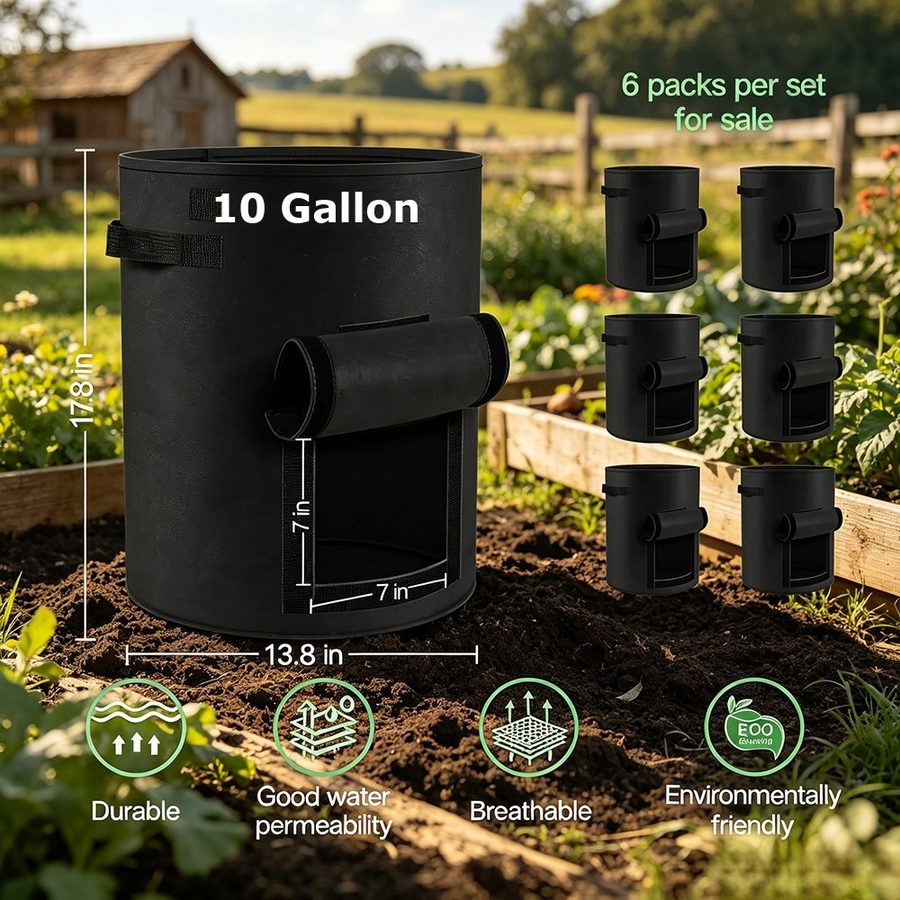
A customer buys twenty small bags because they fit the terrace, plants tomatoes in them, and by July the plants are watering twice a day, setting fruit late, and drying out to the point of wilt every afternoon. The bag did exactly what it was built to do. It was simply the wrong volume for the crop.
So before fabric, seams or colour, the first decision is how much root space the plant needs. Here is how we think about it.
A fabric bag is a limited water reservoir that loses water from every surface. The smaller the volume, the faster the whole thing swings: wet to dry in an afternoon, dry to wet again at the next watering.
A large volume buffers that. The middle of the bag stays moist while the surface dries, and the roots have somewhere to go that is not the hot outer wall.
This is why a tomato that sulks in a small bag will thrive in one twice the size, with the same fabric, the same mix and the same watering can. Volume is the variable people under-buy.
These are working figures, not rules handed down from above. They assume a decent loose mix and a full season.
| Crop | Bag volume | Plants per bag | |---|---|---| | Herbs (basil, parsley, coriander) | 3-7 litres | 1-3, tight together | | Salad greens, rocket, spinach | 10-20 litres | sown in rows across the width | | Peppers and chilli | 15-20 litres | 1-2 | | Bush tomato, determinate | 20-30 litres | 1-2 | | Cordon tomato, indeterminate | 30-40 litres | 1 | | Cucumber, courgette, squash | 30-40 litres | 1 | | Aubergine | 20-30 litres | 1 | | Potatoes, early | 20-30 litres | 2-3 seed tubers | | Potatoes, maincrop | 40-50 litres | 2-3 seed tubers |
The two rows that surprise people are the bottom ones. A cordon tomato needs more root volume than most patio bags offer, and maincrop potatoes need almost double what early varieties do, because they are in the bag longer and bulk up heavier.
"Two to three plants per bag" is advice you see everywhere, and it is really a statement about competition for water, not about space.
Two plants in a 20 litre bag share a reservoir that was sized for one and a half. They will survive, and the bag will be permanently on the edge of dry. In hot weather the pair uses water faster than any hand watering routine can keep up with, and the yield loss shows up as small fruit rather than dead plants, which is why people do not connect it to the bag.
If you want a full bag, go one size up rather than adding a third plant. It costs less than the extra water and the lost fruit.
Most of the table above is about volume, but two crops are also about depth.
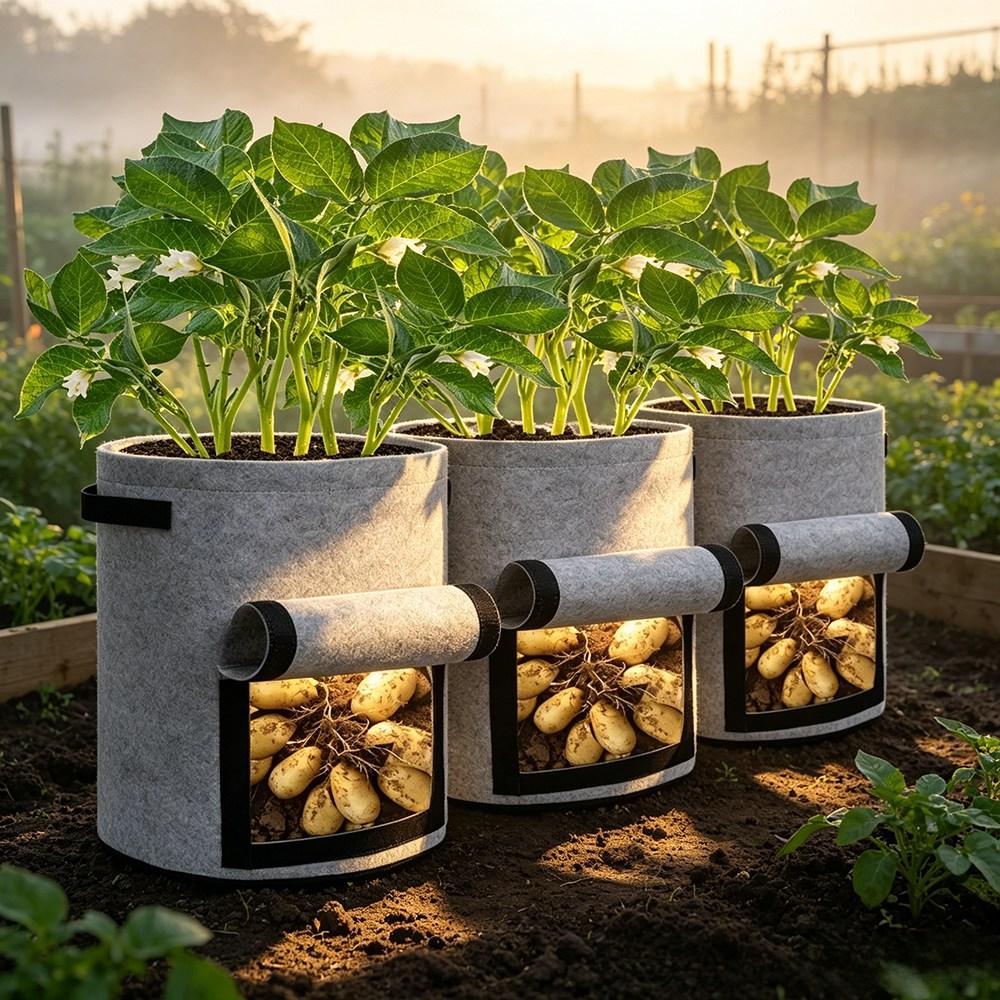
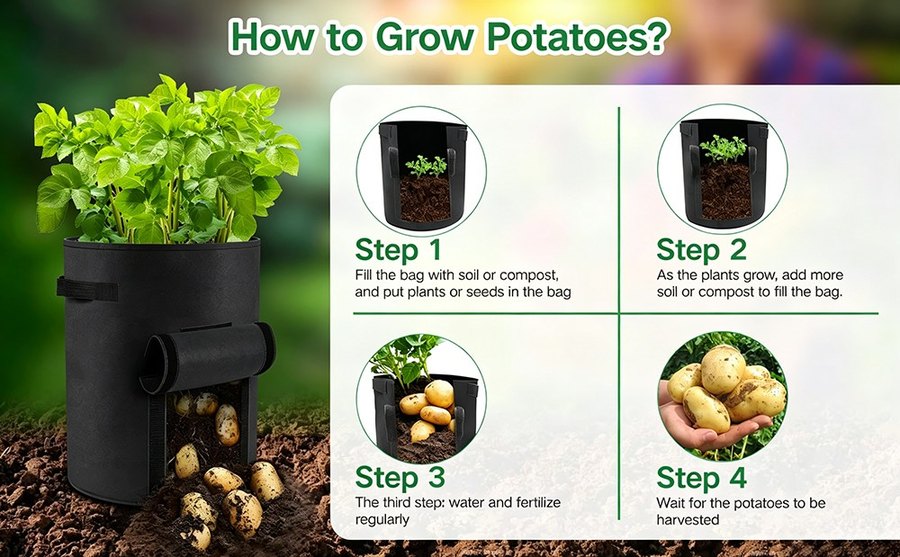
Potatoes need room to hill up. A proper potato bag is tall, and the good ones open at the bottom or have a flap so you can lift the tubers without tipping the whole thing out. Maincrop varieties are the case for the 34 gallon heavy-duty bag rather than a patio size. If you are using a shallow bag, you will get potatoes, just fewer and greener.
Tomatoes root along the stem if you bury it deep, which is how you get a second root system. A bag that is wide but shallow takes that option away. Deeper is better than wider for a cordon tomato.
Fabric affects how fast the bag dries, how the roots behave at the wall, and how long the bag lasts. It does not change how much water the plant needs in a week, which is set by the volume and the weather.
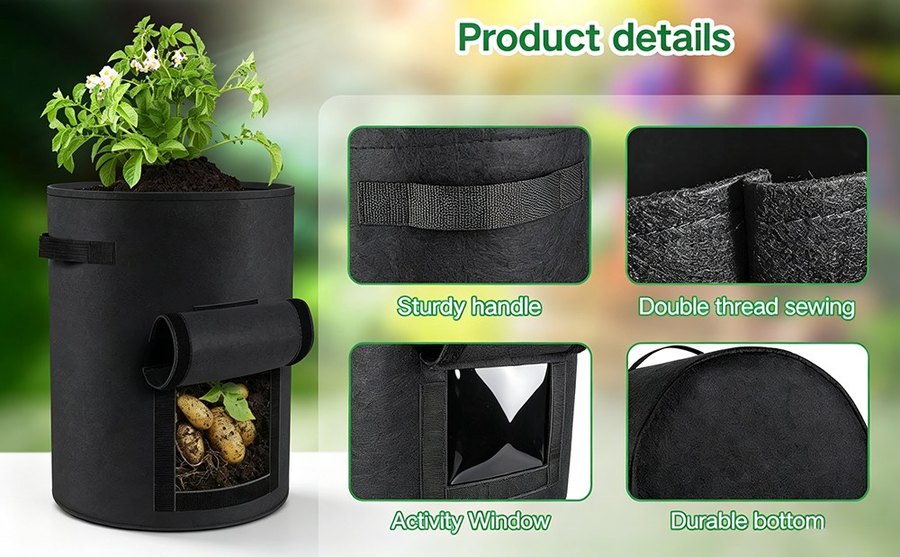
Two practical notes from our own production. Our non-woven bags run at 260-320 gsm, which is heavy enough to hold shape when lifted wet and light enough to stay workable. Heavier fabric lasts longer and dries slightly slower; it also costs more, and for a one-season salad crop that money is better spent on a bigger bag.
A small volume of compost runs out of nutrients faster, because there is less of it and because it is being flushed more often.
That is why the feeding advice that works in a bed does not transfer directly. In a 20 litre bag, a tomato will need liquid feed from the moment the first truss sets, not from mid-season. In a 50 litre bag, the same plant has more reserve and can go longer on what is in the mix.
The old guidance to switch to a high-potash feed when flowering starts is still right. It is the timing of the first feed that moves with the bag size.
Empty the bag, brush out the roots, and let it dry completely before folding. Stored damp, a fabric bag goes mouldy and the fabric weakens at the fold lines. Stored dry and flat, ours are built for five years of normal use, and customers who bought thicker bags report getting several seasons out of them before the fabric goes slack.
When a bag starts to sag rather than hold its shape, it has stopped being a container and become a sack. That is the point to replace it, not when it first shows a stain.
Sichuan Zhifang Net Industry Co., Ltd. has been making non-woven grow bags and shade netting since 2011, from a plant of nearly 10,000 m² with more than 50 production lines, and supplies growers in 32 countries. Our bags are 260-320 gsm non-woven fabric with reinforced handles and stitched seams, built for five years of normal use, and every carton carries a ZF security label inside the pack.
You can keep it alive. It will dry out daily, set fewer trusses and produce smaller fruit. If space is the constraint, grow a determinate bush variety rather than a cordon.
Two or three seed tubers, planted two thirds down and earthed up as they grow. More than that and the tubers come out small.
More water per bag, less per plant, and far less lost to runoff and evaporation from an overheated small volume. A large bag is usually the more efficient container per kilo of crop. If you are choosing sizes for a nursery line, the planting bag range lists volume and GSM per item, and the heavy-duty options are the ones worth looking at for multi-season use.


