
By Mark Wu, Co-founder & Technical Director, Sichuan Zhifang Net Industry Co., Ltd.
In a long season, the most valuable square metre of a bag garden is the one that has just been emptied.
A grower pulls a finished crop, looks at the spent medium, and stops. The bag sits idle for the rest of the summer, or gets a tired transplant dropped into it with no preparation. Meanwhile the same bag, turned over properly in half an hour, would carry a second crop to harvest before the weather folds.
Turnover is the part of bag growing that nobody writes about, and it is where the difference between an average season and a good one usually sits.
The signal is not death. A plant that is still green but has stopped producing is costing you water, feed and space for nothing.
For fruiting crops, look at the size and count of what is coming off. When the fruit gets smaller for two consecutive pickings, or the trusses stop setting, the plant has moved from production to maintenance. Leafy crops tell you earlier: the regrowth after cutting gets thinner and slower until it stops being worth cutting.
That is the moment to empty the bag. Waiting another fortnight to see if it recovers is the most common way a season loses one whole crop.
By the end of a crop, three things have happened in the bag.
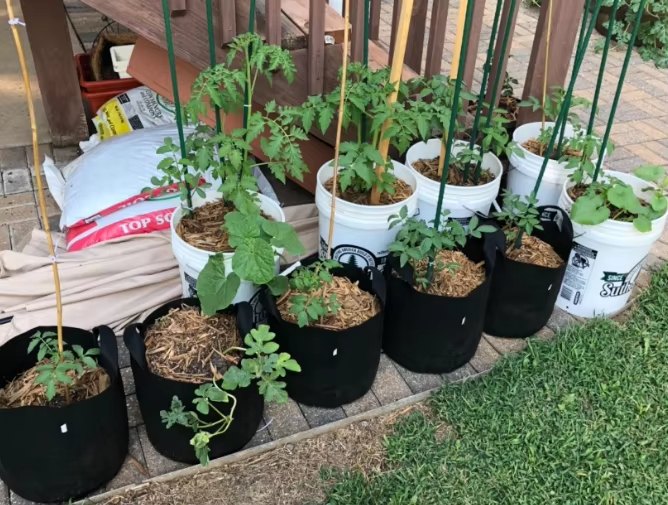
The roots have filled the volume, so there is no unoccupied medium left for a new plant. The medium has compacted and lost some of its structure, especially where it has been watered from the top all season. And the nutrients you started with have largely gone out through the wall with the water.
None of that is a reason to throw the medium away. It is a reason to change its condition before the next plant goes in.
Pull the plant, and shake the root ball gently over a barrow. Most of the medium will fall away; what stays attached to the root mass goes out with it.
Then put back roughly half the volume as fresh material. Not all of it, and not none. Keeping half preserves the biology that has built up over the season, which is genuinely useful. Replacing half restores the structure and the nutrient reserve that the first crop used up.
Mix the two together rather than layering them, top up to within a few centimetres of the rim, and firm it against the wall as you fill. If the bag is going back onto the same spot, give the base a check for roots that have grown through it and out onto the floor.
Then plant, water in two passes, and treat it as a new crop from there.
The simple rule is that the second crop should not be another heavy feeder from the same family.
A tomato followed by another tomato in the same bag is how you concentrate whatever root problems the first one had. A fruiting crop followed by a leafy one works well, because the leafy crop wants nitrogen and finishes fast. A legume in the rotation puts something back rather than taking it out.
In practice, in a bag, this is easy: you are not moving a bed, you are writing a line in a notebook and choosing a different seed.
Replanting into exhausted medium with no feed. The second crop starts in a bag that has been through a season. Unless the refresh includes fresh compost and a slow-release feed, it will run out of nutrition at exactly the point it needs it most.
Leaving the old root mass in. Old roots break down and consume oxygen while they do it, and any disease they carried stays in the bag. Shake them out. This is the single most skipped step and the one that costs the most.
If the second crop needs support, decide it at planting, not in August.
Stakes driven into the medium do not hold well, because potting mix does not grip like soil. Put the cage on the outside of the bag, or drive stakes into the ground beside it, or run a panel behind the row. Doing this after the plant has grown means working around a root system that is already in place.
A dark bag in full sun gets hot on the sunward side, and the medium inside it gets hot with it. Root temperature matters more in a bag than in a bed, because the whole volume is above ground and exposed.
Light-coloured bags run cooler. Where that is not an option, shade the bag body rather than only the plant above it, or group the bags so that the sunward faces are shielded. A second crop planted in late summer is going into the hottest medium of the year, so this is not a small detail.
Sichuan Zhifang Net Industry Co., Ltd. has been making non-woven grow bags and shade netting since 2011, from a plant of nearly 10,000 m² with more than 50 production lines, and supplies growers in 32 countries. Our bags are 260-320 gsm non-woven fabric with stitched seams and reinforced handles, built for five years of normal use, and every carton carries a ZF security label inside the pack.
Usually yes, if the first comes out early enough for the second to finish. In a long, warm season three is possible with fast crops. The limit is daylight and temperature, not the bag.
Replace about half. Keeping all of it leaves the second crop short of nutrients and structure; replacing all of it throws away the biology you spent a season building.
Another nightshade. Peppers, aubergines and potatoes share the same soil-borne problems. A leafy crop or a legume is the safer follow-on. For the sizes used in succession blocks, the planting bag category lists volume per item, and the heavy-duty grade is what we recommend when a bag is going to carry two crops a year. Larger containers for the long-season crops are in the 34 gallon range.


