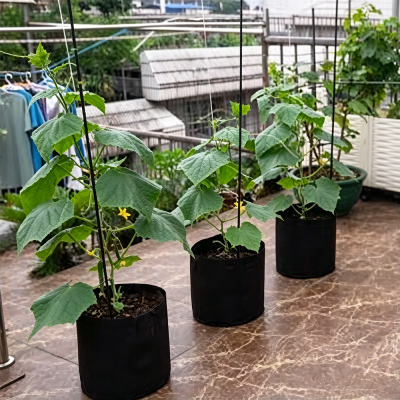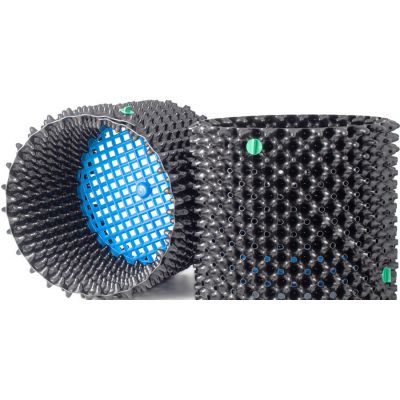


Wall thickness decides how hard this pot air prunes. This 0.6-0.7 mm PET pot keeps the sidewall firm enough to hold its shape through repeated handling, while the openings stay large enough to dry root tips the moment they press against them. Height and diameter share the same 20/30/40/50/60 cm ladder, so a pot can be matched to the root ball it is meant to hold rather than forcing a near fit. Black pigment is added to the base compound, which blocks the light that would otherwise draw algae into the medium. Packs in a woven bag or carton, and custom sizes are accepted for distributors filling their own containers.
The pot works by letting air reach the root tips instead of trapping them against the wall. Roots that circle a smooth inner surface keep thickening in circles and never branch; roots that meet an opening lose their tip to dehydration, so the plant pushes lateral fibrous roots outward instead. That 0.6-0.7 mm PET wall is what makes the difference on a commercial run: thin enough to stay flexible when it is filled and stacked, thick enough that the rim and sidewall openings do not tear during nursery handling.

Air pruning is not a hole pattern, it is a drying process, and the wall thickness sets how fast it works. At 0.6 mm the sidewall stays flexible enough for the pot to nest into a stack without cracking, and the openings hold their shape instead of sagging shut. PET is used rather than PP because it takes repeated wet-dry cycles without going soft, which matters when the same pot is turned out, washed and reused across seasons. The same 20/30/40/50/60 cm step applies to both height and diameter, so the pot can be sized to the root ball instead of being trimmed to fit.

Propagating woody species for a nursery is the main job: olive, citrus, fruit rootstock and nursery trees all spend their first season here, where a dense fibrous root ball is worth more later than a fast-growing one. Second use is holding rooted cuttings and young liners until planting out, where the same sidewall openings stop the root mass from binding against the pot before it is moved. Hydroponic and substrate growers use them as the transition pot between propagation and the final planting site. Existing fabric and non-woven planting bags cover the grower who wants a bag format instead of a rigid pot.

| Use | Plant root nursery, root vigorous growth |
| Height | 20/30/40/50/60 cm |
| Diameter | 20/30/40/50/60 cm |
| Thickness | 0.6 mm, 0.7 mm, customised accepted |
| Material | PET |
| Colour | Black, customised accepted |
| MOQ | 50 meters |
| Package | Woven bag, carton |

Fill substrate loosely rather than tamping it, and leave the top rim free so the sidewall openings stay unblocked once the first roots arrive. Pots stack when empty and still nest when filled, so a 50 meter run covers a bench without overloading it. Packed in a woven bag or carton, they arrive ready for filling; distributors filling their own containers can order a custom size on the same diameter ladder. Sized nursery stock trees use the same pot body in a taller step, comparable to air pruning pots for trees.

MOQ is 50 meters per size, and custom dimensions follow the same production route. Sample pots are available for checking wall thickness and opening size before a bulk order. Distributors can group the 20 through 60 cm steps into one shipment to keep the size range complete on arrival. Field reports on propagation media and liner handling are published regularly by HortiDaily and FreshPlaza.
How does an air pruning pot stop roots from circling?
The sidewall openings expose the root tips to air, which dries them and stops elongation. The plant responds by branching sideways, so the root ball becomes dense and fibrous instead of circling the pot wall.
What is the difference between the 0.6 mm and 0.7 mm wall?
Both run in the same size range. The 0.6 mm wall is lighter and nests tighter in a stack, while the 0.7 mm wall holds its rim shape better under repeated filling and washing. Most nursery buyers take 0.6 mm for liners and 0.7 mm for larger trees.
Can these pots be reused after a season?
Yes. PET tolerates repeated wet and dry cycles without going soft, so pots are normally washed, sanitised and used again for the next propagation batch.
Tell us the sizes and quantities you want to run this season, and we will confirm the packing plan and lead time.
Mark Wu, Co-founder & Technical Director, Sichuan Zhifang Net Industry. 15 years manufacturing agricultural nettings for growers in 32 countries.