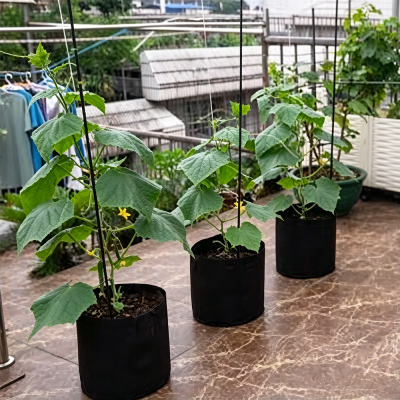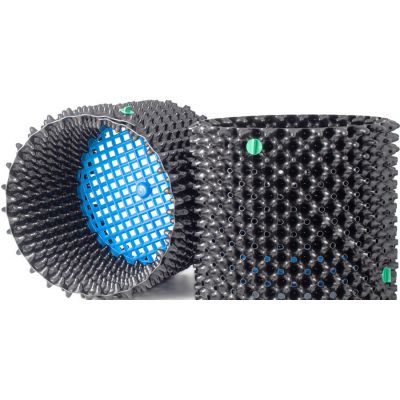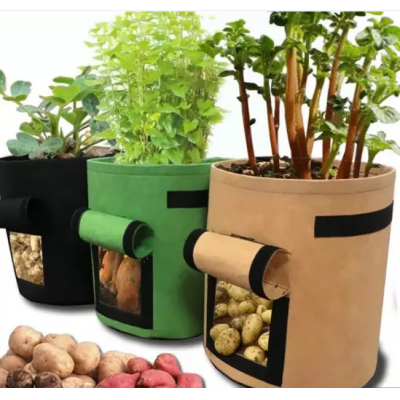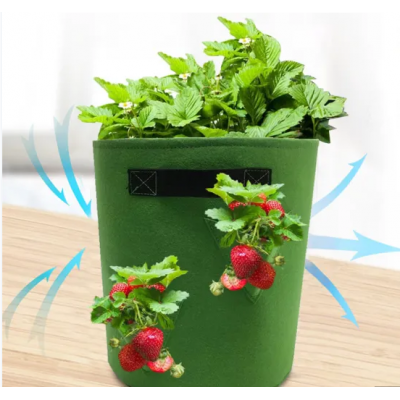


An olive or orchard tree spends its nursery years deciding what kind of root system it will carry to the field, and the pot it is grown in makes that decision for it. This deep root pot keeps the column tall enough for a taproot to run straight down before it thickens, while the perforated wall air-prunes the laterals that would otherwise circle at the base. PE holds its shape through wet orchard winters and repeated lifting, and the panel-and-base build lets one size run across a whole planting programme. Diameters run 20 to 70 cm with matching base plates, black as standard.
An olive tree does not forgive a bent taproot. Deep-rooted species put their first investment into a single descending root, and a shallow pot turns that root into a coiled spring the tree carries for decades. This pot is built around the opposite idea: a deep column that lets the taproot run, with an air pruning face that keeps the laterals from choking the base.

A deep pot without air pruning only gives a root more room to circle; air pruning without depth prunes the roots that matter least. The two work as a pair. The perforated, studded wall dries the root tips that press against it, so the tree pushes fibrous laterals instead of a whip that coils the full height of the pot. PE compound is chosen for outdoor duty: it keeps the wall stiff through rain, irrigation and lifting cycles, and the fixing holes stay true so a panel can be re-tensioned after seasons in the yard. The same wall logic runs across the whole air pruning pot family, from seedling sizes up to tree builds.

Orchards and olive groves are the first users: young stock grows on until the trunk callipers up, then moves to the field with the root ball intact. Forestry and shade tree nurseries run the same regime, standing saplings in the pot yard through the first seasons instead of lining them out. Fruit and berry growers take the deeper sizes to keep a taproot straight when circling roots would do the most lasting damage. Stock that outgrows a single pot moves into the taller builds in our air pruning pots for trees, which follow the same wall and fixing system.

| Use | Olive tree, orchard and forestry stock propagation |
| Material | PE, PVC |
| Diameter | 20-70 cm, customised accepted |
| Height | 20-70 cm |
| Thickness | 0.6 mm to 1.2 mm, customised accepted |
| Colour | Black, customised accepted |
| Base plate | 20-60 cm |
| Samples | Available |

Assembly follows the panel-and-base logic: roll the wall to the diameter you need, join the edges with the fixings, and seat the base plate. A screwdriver does the whole job, and the same tool re-tensions the seams after a season. Empty pots nest flat and stack tight; loaded pots lift safely by the rim. Because the wall is a panel and the floor is a plate, a single damaged part is replaced on its own instead of retiring the pot. The fixing pattern repeats across sizes, so one spares box covers a whole pot yard.

Diameters and heights both run 20 to 70 cm, and base plates cover 20 to 60 cm so the floor matches the stock. Panels ship flat and stack tight, which keeps freight volume down on full container loads. Print and packaging run to your own label, and sample panels let you check wall thickness against your own growing mix before a bulk order. Where a programme needs flexible containers for the same stock, the planting bag range covers a soft-wall alternative. Orchard planting practice and nursery trials are covered in the field by HortiDaily and FreshPlaza.
Why does pot depth matter more for olives than pot width?
Olive and other deep-rooted species commit early to a descending taproot. Width helps the laterals, but depth is what lets the taproot run straight before it thickens. Once it coils, later repotting cannot straighten it, and the tree carries that defect to the field.
Can these pots be lifted and moved once filled?
Yes. The rim takes the load and the base plate supports the root ball from underneath, so a filled pot is moved by two people or a barrow without the panel flexing away from the fixing line.
What panel thickness is right for an orchard programme?
The 0.6 mm to 1.2 mm range covers both ends. Lighter panels suit lift-and-sell stock that ships in the pot; heavier walls hold crisper rims for stock standing two or three seasons in the yard. Samples settle it fastest, since the answer usually depends on how often the pot is moved.
Send the sizes, panel thickness and quantities your orchard programme needs, and we will come back with the packing plan and lead time.
Mark Wu, Co-founder & Technical Director, Sichuan Zhifang Net Industry. 15 years manufacturing agricultural nettings for growers in 32 countries.