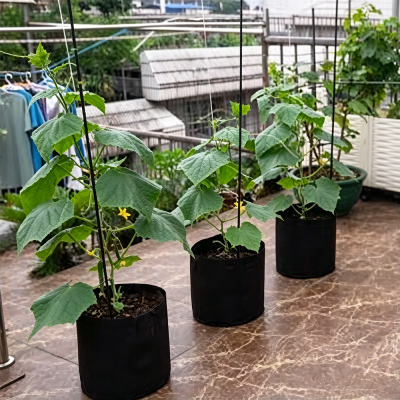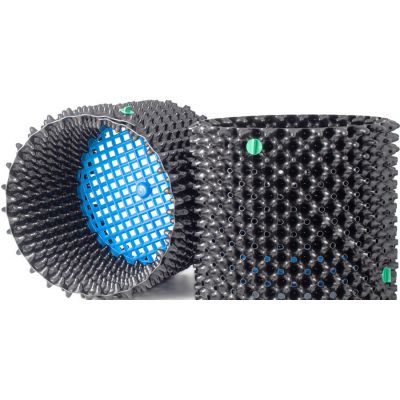


Seedling density is where a propagation house makes or loses its margin, and the container decides how far you can push it. These pots run at close spacings without the roots leaving the pot worse for it: the slotted wall stops tips at the surface, so a full bed still fills with fibrous, self-supporting root balls instead of interlocking coils. Light and stackable, they cut both storage and handling between batches, and the UV stabilised PP/PE body survives season after season of dense production. Diameters run 20 to 70 cm, black as standard.
Density is how a nursery makes its margin: more plants per square metre, as long as the roots come out right. Run smooth-walled containers at close spacing and they do not, because every pot in the row keeps feeding the same problem. These containers are built for dense benches: the slotted wall stops root tips at the surface, so a full house still fills with fibrous plugs and liners instead of coils.
Tight spacing changes what a container has to do. Airflow matters more when the pots touch: the slotted wall keeps the root zone open to it, so the medium breathes at the base even in a packed house. Drainage matters more when one drip line feeds a thousand pots: the openings let excess water leave the column instead of pooling at the bottom. And root control matters most of all, because a coiled plug is a lost plug at these volumes. The wall prunes the tips that reach it, the plant answers with branched fibrous roots, and the bench keeps its quality at any spacing. The same wall system runs across the air pruning pot range, from plug rounds to liner sizes.

Greenhouse benches are the first setting: rows of containers at close spacings, one drip line, and the same root quality across the house. Tree and shrub lines run the larger rounds for liner production, where the pot moves up with the stock as it grows. Vegetable and herb growers use the smaller sizes for starts that go straight to the field, and hydroponic benches take the pots where a plug has to lift out cleanly. Where growers raise their own stock, a germination and seedling tray covers the seed stage before the plants move into these containers.

| Use | High density nursery and greenhouse propagation |
| Material | UV stabilised PP/PE |
| Diameter | 20-70 cm |
| Height | 20-70 cm |
| Thickness | 0.6-1.2 mm |
| Colour | Black |
| Base plate | 20-60 cm |
| Samples | Available |
At production density the ergonomics matter as much as the growing. These pots are light enough to lift a filled one by the rim with a single hand, so moving a bench or a trolley load stays a one-person job. Empty, they nest and stack flat, and the storage aisle between crops takes a fraction of the floor loose containers need. The UV stabilised PP/PE body also resists the cracking and warping that retire ordinary containers early, so the same pots come back season after season of continuous production.
Diameters and heights run 20 to 70 cm, and base plates cover 20 to 60 cm, so a propagation programme can hold one system across plug rounds and liner containers. Panels ship flat and nest for freight, packing runs to your own label, and samples let you test the wall against your own misting and spacing plan before a bulk order. For soft-wall containers in the same programme, the planting bag range covers the flexible alternative. Production practice and nursery economics are covered in the field by HortiDaily and FreshPlaza.
Do the pots perform differently at close spacings?
The wall is what keeps performance stable in a dense house: airflow and drainage keep working even when the pots touch, so root quality does not drop as the bench fills up.
How much handling do they save?
They are light for their size, they lift by the rim, and they nest when empty, so bench moves and winter storage both take less labour and less floor space.
What sizes suit dense propagation?
Smaller rounds carry plugs and vegetable starts, mid sizes hold liners, and the larger rounds take tree stock up to sale size, all on one fixing system.

Send the sizes, spacing plan and quantities your propagation programme runs, and we will come back with the packing plan and lead time.
Mark Wu, Co-founder & Technical Director, Sichuan Zhifang Net Industry. 15 years manufacturing agricultural nettings for growers in 32 countries.