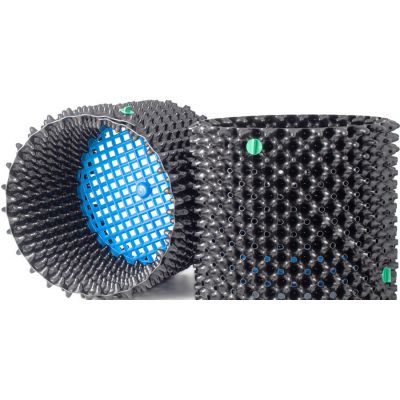


In reforestation and timber planting the maths is blunt: every seedling that fails is a replanting cost, and the container decides how many fail. This pot builds a dense, fibrous root plug that leaves the nursery intact and goes into the ground ready to take up water, which is what keeps survival high through the first season. The split panel opens on lock screws so the plug lifts out without root disturbance, and panels ship flat to the planting site, cutting freight volume on bulk orders. Diameters and heights run 20 to 70 cm with custom dimensions and thicknesses accepted.
Reforestation and timber planting run on survival rates: every seedling lost to a coiled root system is money spent twice, and every plug that lifts out intact is establishment the programme does not have to redo. This container is built for that equation, from the root contact at the wall to the way the pot travels to the planting site.
A seedling grown in a closed container arrives at the field with roots circling the old wall, and the first dry week finishes what the nursery started. Roots grown against the open wall of this pot meet air instead, stop at the tip and branch into the medium, so the plug that leaves the nursery is fibrous, dense and immediately able to draw water after planting. That single property carries the whole arithmetic of a planting programme: fewer replacements, faster establishment, less labour spent on second plantings. The same root wall runs across the air pruning pot range.


Getting a seedling out of its container without tearing the root ball is the step that decides whether establishment succeeds. This pot is built as a split panel held on lock screws, so the side opens away from the plug and the root mass lifts out whole, undamaged and ready to plant. Once the seedling is in the ground, the panels screw back together and the container returns to service after cleaning, which is what makes the system economical across several seasons of a programme.


| Use | Reforestation, timber plantations, transplant nurseries |
| Material | PE/PVC |
| Diameter | 20-70 cm, or customised |
| Height | 20-70 cm, or customised |
| Thickness | 0.6-1.2 mm, or customised |
| Base diameter | 20-60 cm |
| Colour | Black, or customised |
| Customisation | Accepted |
| Samples | Available |

The two big users of this container work at different scales but want the same thing. Government and agency forestry programmes order in bulk for landscape and watershed planting, where survival reporting matters as much as price; commercial timber operations plan by species and rotation, and specify panel dimensions and thicknesses against the target tree. Both run containers through a nursery phase and then out to the field, and both save the most when the root plug arrives intact. Larger format sizes in the programme run in the tree and nursery container range.

Panels and bases ship flat and nested, so a bulk order moves in a fraction of the freight volume of assembled containers, and storage between planting seasons takes the same discipline. Custom dimensions, thicknesses and colours run alongside the standard 20 to 70 cm ladder, and samples let a programme test the split panel and lock screws against its own handling routine first. For soft-wall containers in the same programme, the planting bag alternative covers flexible growing. Trade coverage of growing practice runs at HortiDaily and FreshPlaza.
How does the pot improve transplant survival?
Roots branch into a dense, fibrous plug instead of coiling, and the split panel lets that plug lift out undamaged, so the seedling goes into the ground ready to take up water immediately.
Can dimensions be specified per species?
Yes. Diameters and heights run 20 to 70 cm with custom sizes and thicknesses from 0.6 to 1.2 mm accepted, so a programme can match the container to the target tree.
How do bulk orders ship?
Panels and bases ship flat and nested, which cuts freight volume sharply compared with assembled containers, and keeps storage compact between planting seasons.

Tell us the species, dimensions and volumes your programme plants and we will come back with the packing plan and lead time.
Mark Wu, Co-founder & Technical Director, Sichuan Zhifang Net Industry. 15 years manufacturing agricultural nettings for growers in 32 countries.