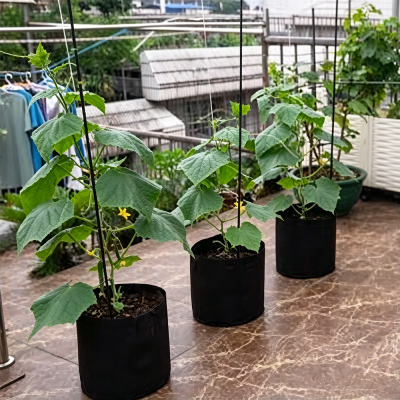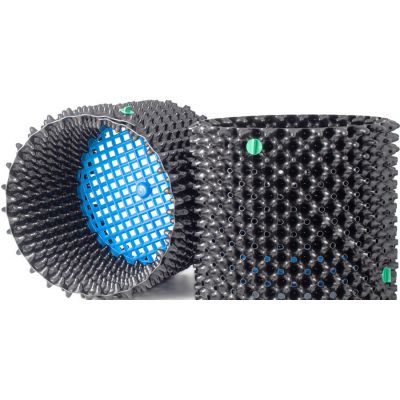


A root that circles its container is a root that girdles the tree years later, and nursery stock rarely gets a second chance to fix it. This container is built to send roots the other way: the open sidewall stops tips at the air, the plant branches into a dense fibrous mass, and growth is directed downward instead of around. The PE body runs 0.6 to 1.2 mm walls that resist cracking and weathering through repeated nursery cycles. Diameter and height both cover 20 to 70 cm with bases from 20 to 60 cm, stacking flat between crops.
Girdling is the quiet killer of container-grown trees: roots circle the old wall in the nursery, and years after planting the same roots strangle the trunk they were supposed to feed. This container is built to break that cycle before it starts.
The open sidewall stops every root tip that reaches it at the air, and the plant answers by branching a dense fibrous mass through the medium instead of spiralling the wall. Growth is directed downward rather than girdling, which is what raises transplant survival once the tree goes into the ground and has to find water on its own. The PE body carries that job through season after season: 0.6 to 1.2 mm walls resist the cracking and weathering that retire thinner containers early in a nursery rotation. The same wall runs across the air pruning pot range.


The sizes run unbroken from 20 to 70 cm in both diameter and height, with base plates from 20 to 60 cm, so a nursery can hold one root-control method from the first liner pot to the final tree container without switching systems halfway. Stock moves up the ladder as it grows, and every step keeps the same open-wall behaviour that the previous size had. Customisation is accepted across the range for programmes that sit between standard steps.


| Use | Nursery growing, liner and tree stock, transplant programmes |
| Material | PE |
| Diameter | 20-70 cm |
| Height | 20-70 cm |
| Thickness | 0.6-1.2 mm |
| Base diameter | 20-60 cm |
| Colour | Black |
| Customisation | Accepted |
| Samples | Available |

The same container covers both a production nursery and a protected house. Outdoors it runs in long rows through the growing season, stacked flat for storage in winter; under glass it lines benches and supports vertical training systems where the root zone stays pressed against the wall all year. Either way, the plant leaves with a root mass that holds together and establishes without a check. Where a nursery raises its own stock from seed first, a seedling propagation tray covers the opening stage.

Panels and bases come off our own production line, which is what keeps custom sizes and bulk quantities realistic on a schedule: orders are quoted by size and volume, packed flat and nested for freight, and samples are available before a full run. For soft-wall containers in the same programme, the planting bag alternative covers flexible growing. Trade coverage of growing practice runs at HortiDaily and FreshPlaza.
What does air pruning do for girdling roots?
Tips that reach the open sidewall stop at the air, so roots branch into the medium and grow downward instead of circling the wall and girdling the tree later.
What does the 20-70 cm ladder cover?
Diameter and height both run the full 20 to 70 cm span with bases from 20 to 60 cm, so one root-control method carries stock from liner size to sale size.
How long do the containers last?
The PE walls resist cracking and weathering through repeated nursery cycles, and panels stack flat between seasons for clean storage.

Tell us the sizes, volumes and growing schedule you run and we will come back with the packing plan and lead time.
Mark Wu, Co-founder & Technical Director, Sichuan Zhifang Net Industry. 15 years manufacturing agricultural nettings for growers in 32 countries.