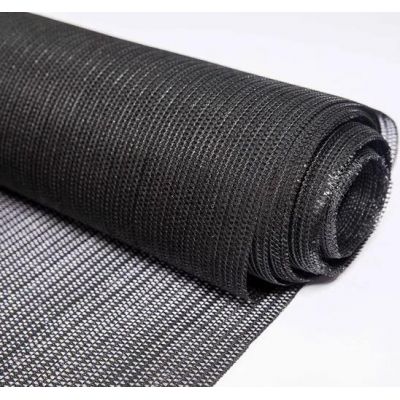


Net wrap is usually discussed as a handling product, but on hay it is also a quality product. Leaf carries the protein, and leaf shatters off a bale that is handled roughly or that lets water in at the surface. A net that lies flat keeps the surface smooth so rain runs off instead of soaking in, and a bale that stays intact keeps the leaf it was baled with. Spoilage drops by up to 50 per cent on that basis, and leaf retention is what shows in the analysis. The mesh is 100 per cent new HDPE with a UV anti-aging formula, warp knitted at 8.33 or 10 gsm.
On hay, what the buyer is paying for is largely leaf, because leaf is where the protein sits and stem is where it does not. A bale that keeps its leaf through wrapping, storage and handling grades better, and the net is one of the things that decides whether it does.
Leaf shatters off a bale that is handled roughly, and it also comes away where water has softened the surface layer. Both of those are influenced by the net: one by how tightly and evenly it holds the bale through handling, and the other by whether the netting surface lets rain run off or holds it against the hay. The net here lies flat on the bale, which keeps the surface smooth so water does not collect in it, and bales netted this way show spoilage reduced by up to 50 per cent. Better leaf retention is what that translates into at the analysis, and on a hay crop that is the difference between a lot that grades and one that does not.
The net is warp knitted to hold tension on both round and square balers, and it needs only two to three revolutions to cover a bale, which shortens the wrapping cycle and reduces the load the mechanism carries. It is supplied in the widths the common baler models take rather than a fixed few, and the mesh is easy to cut off without losing the end, which matters at feeding time. More on how netting fits into a bale handling setup is covered under bale net wrap, alongside the shade net and planting bag ranges that go to the same farms.
| Material | 100% new HDPE with UV anti-aging formula, warp knitted |
| Net weight | 8.33 g/m2 or 10 g/m2 |
| Net width | 1 m, 1.22 m, 1.23 m, 1.62 m, 1.7 m, or to your requirement |
| Roll length | 2000 m, 2134 m, 2500 m, 3000 m, or to your requirement |
| Tension | 35 to 55 N across the two weights |
| Coverage | Two to three revolutions per bale |
| Packing | Rolls on cardboard tubes, 16 or 12 rolls per pallet |
| MOQ | 2 tons |
The mesh is made to sit flat on the bale rather than riding up in ridges, and a smooth netted surface is what makes rain run off instead of collecting. Once water sits on a bale it works into the surface layer, and the surface layer is where the leaf is, so spoilage and leaf loss are the same problem seen from two directions. The UV anti-aging formula in the yarn is what stops the mesh going brittle at the folds over a season outdoors, because the fold lines are where a net under tension fails first. Tension runs from 35 to 55 N depending on weight.
Widths run from 1 m to 1.7 m and roll lengths from 2000 m to 3000 m, all made to order, so a baler with a non-standard width is not a problem. Rolls are packed on cardboard tubes, 16 or 12 to a pallet, and a 20 ft container takes around 190 to 210 rolls against 490 to 510 in a 40 ft high cube. Capacity is 400 tons a month and delivery is about 15 days from deposit. Tell us the baler, the width, whether the crop is hay or silage and the annual volume, and we will confirm the weight and the roll length. Buyers tracking what is going into hay and silage operations can follow trade coverage such as HortiDaily and FreshPlaza for what growers are installing.
How does netting affect hay quality?
Leaf carries the protein, and leaf is lost where a bale is handled roughly or where water has softened the surface. A net that holds evenly and sheds water keeps more of it in the bale. Tell us the crop and the storage.
How much does spoilage drop?
On bales netted with this mesh the figure quoted is up to 50 per cent less spoilage, which comes from the flat surface shedding water rather than holding it. Tell us the storage period.
Will the mesh go brittle outdoors?
The yarn carries a UV anti-aging formula, which is what keeps it flexible at the folds through a season in the sun. Tell us how long the bales are stored.
Tell us the baler, the width, whether the crop is hay or silage and the annual volume, and we will confirm the specification, the sample and the packing that suit your order.
Mark Wu, Co-founder & Technical Director, Sichuan Zhifang Net Industry. 15 years manufacturing agricultural nettings for growers in 32 countries.