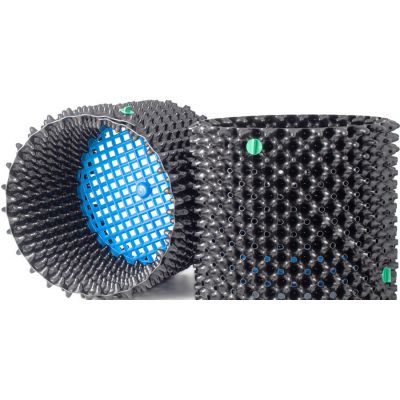


A bonsai is judged by its root pad, and a root pad is shaped by the container it grew in. Ceramic restricts root work; this pot drives it. Perforated walls expose the root tips as they arrive, so instead of circling, the tree pushes secondary roots and lays down the fine feeder structure a valuable tree is built on. The split panels and lock screws then open around the pad for inspection or repotting, and close again without losing shape, which is what a working nursery needs at every stage change. The body is 1000 GSM UV resistant PE and takes repeated assembly without cracking. Sizes run 20 to 70 cm, black as standard, custom on request.
Bonsai growers judge a tree by what is under the soil: a root pad that is flat, dense and full of fine feeders. That pad is not something a tree chooses to grow, it is something the container trains, and a smooth-walled pot trains it the wrong way. This container is built for the root work itself, from the first training pot to the display container.

In a glazed or ceramic container, roots meet a sealed wall, turn, and keep turning, and the tree ends up with a few thick roots circling the base. Bonsai work needs the opposite: many fine roots, evenly spread, so the tree can be lifted, combed and reset without losing its anchor. This pot trains that structure by exposing root tips through perforated walls. A tip that reaches the opening dries and stops, and the tree answers with secondary roots behind it. Season by season the pad builds up: flat, branched and feeder-rich, which is exactly what the trees are sold and judged on. The same wall logic runs through the whole air pruning pot range, from liner rounds up to specimen containers.

Bonsai and penjing nurseries are the first users: stock moves through the pots as it is grown on, and the root pad is inspected at every stage change instead of at the end of the process. Ornamental nurseries use the same container for topiary, patio trees and specimen tree stock, where a compact, fibrous root mass sells the plant as much as the canopy does. Growers in mild climates also run the pots for citrus and other container fruit, where root control keeps the tree fruiting instead of filling the pot with wood. Sizes step from compact training rounds to 70 cm containers on one build system.

| Use | Bonsai and ornamental nursery root training |
| Material | PE, PVC |
| Weight | 1000 GSM |
| Diameter | 20-70 cm, customised accepted |
| Height | 20-70 cm |
| Thickness | 0.6 mm to 1.2 mm, customised accepted |
| Colour | Black, customised accepted |
| Base plate | 20-60 cm |

The split panels are the working feature for bonsai. Undo the lock screws, and the wall opens around the root pad so it can be inspected, combed or trimmed without levering the tree out of a one-piece pot. The same screws close the panel true again, and the 1000 GSM UV stabilised wall is stiff enough to survive that cycle season after season without the fixing holes going slack. For growers who also line out or pot on into soft containers, the planting bag range covers the flexible alternative on the same programme.

Diameters and heights run 20 to 70 cm, with base plates from 20 to 60 cm, so a training programme can step stock up without changing systems. Panels and plates ship flat and stack tight for freight, packing runs to your own label, and size, colour and wall thickness customise on the same tooling. Samples let you test the panel action against your own root work before a bulk order. Ornamental growing and nursery practice are covered in the field by HortiDaily and FreshPlaza.
Why not just use a ceramic pot for bonsai?
Ceramic restricts root work: the tree can only circle what the wall gives it. A perforated wall turns that around, stopping tips at the opening and pushing the fine feeder growth that a root pad is made of.
Can the pot be opened without disturbing the tree?
Yes. The split panels release on the lock screws and open around the root pad, so the root ball is never levered out of a rigid pot. Inspection and staged repotting both run without shock.
Will the panels survive repeated opening?
The 1000 GSM UV resistant PE is chosen for exactly this cycle. Assembly and opening do not crack the wall, and the fixing holes keep their bite through season after season of root work.
Send the sizes and quantities your training programme runs, and we will come back with the packing plan and lead time.
Mark Wu, Co-founder & Technical Director, Sichuan Zhifang Net Industry. 15 years manufacturing agricultural nettings for growers in 32 countries.