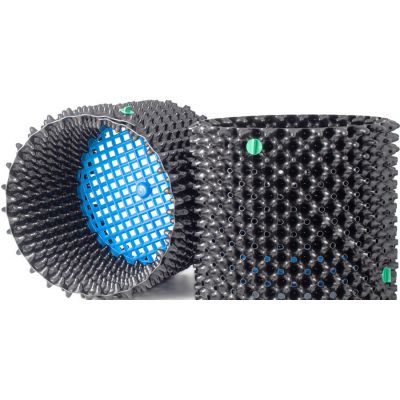


A pot that ships flat and stands rigid once assembled changes the freight equation: the panel rolls open for packing and closes into a round or square section on site, fixed to a base plate with a few screws. PE takes repeated wet-dry cycles without going brittle and stays recyclable at end of life, while the studded wall puts air against the root tips the moment they reach the panel face. Diameters run from 20 to 70 cm on a shared height ladder, and base plates follow the same range, so spares stay simple across a block. Black as standard, with customised colour and private label on request.
Most air pruning pots arrive as a solid tub that spends the whole sea crossing holding nothing but air. This one ships as a flat panel: the wall rolls open for packing and closes into a round or square section on site, fixed to a base plate with a few screws. What reaches the bench is the same wall that left the factory, now standing around the root zone with an air face pressed against it.

The wall and the floor do different jobs, so this pot is built as two parts. The panel carries the air pruning face: a studded, perforated surface that lets root tips dry at the wall instead of coiling against it, so lateral rooting starts in the first weeks. The base plate carries the load, cut one step in from the diameter so the root ball sits clear of the ground and drainage stays open. Because the wall is a flat panel rather than a moulded tub, thickness holds at 0.6 mm to 1.2 mm across a batch, and a worn panel is swapped on its own instead of retiring the whole pot. PE takes misting, fertiliser splash and washdown without going brittle, and at end of life the material re-enters the recycle stream rather than landfill.
Forestry and fruit tree nurseries are the first users: rootstock and liner crops build a denser root ball behind an air pruning wall, and the plug lifts out cleanly for outplanting. Vegetable and herb propagation is the second: a shallower panel on the same base plate suits short-season plugs, and panels wipe down between crops. Medicinal and native plant growers take the deeper sizes for tap-rooted species that would otherwise twist against a smooth wall. Upstream of all of it, a germination and seedling tray covers the plug stage, and the air pruning pot takes over as soon as the seedling needs real root volume.

| Use | Forestry, vegetable and medicinal seedling propagation |
| Material | PE, PVC |
| Diameter | 20-70 cm, customised accepted |
| Height | 20-70 cm |
| Thickness | 0.6 mm to 1.2 mm, customised accepted |
| Colour | Black, customised accepted |
| Base plate | 20-60 cm |
| Samples | Available |

Assembly is deliberately plain: unroll the panel, bring the two edges together, line up the fixing holes and drive the screws. The job takes minutes with a screwdriver, not a workshop, which is why the design suits sites that pack their own containers. The base plate slots under the bottom edge, and full-depth panels take a plate sized one step in from the diameter. Spares are ordered per part, so a single cracked panel or a lost screw set does not take a bench out of production. The fixing pattern is shared across the air pruning pot range, so mixed sizes on one site run on the same spares box.

Diameters run 20 to 70 cm, heights follow the same ladder, and base plates come in 20 to 60 cm so every size has a matching floor. Panels ship flat and stack tight: one pallet carries a propagation block that would cost several pallets as rigid tubs. Print and packaging run to your own label, and sample panels are the fastest way to check wall thickness and opening size against your substrate. Taller panels for tree stock follow the same fixing pattern, comparable to our tree-sized air pruning pots. Grower-facing reports on propagation practice appear regularly on HortiDaily and FreshPlaza.
How long does one pot take to assemble?
Assembly takes minutes, not hours, with a screwdriver. The panel rolls closed by hand, the fixing holes line up on a simple pattern, and the screws seat with light pressure. Sites that pack containers usually assemble pots as they fill the bench rather than in a separate step.
Can a single panel be replaced without ordering a whole pot?
Yes. Panels and base plates are stocked as separate parts, so a cracked face or a bent plate is swapped on its own. That is the practical difference between a panel build and a moulded tub, where one failure retires the whole unit.
What happens to a pot at the end of its working life?
The main parts are PE, and they are built to re-enter the recycle stream at end of life rather than go to landfill, which is where the recyclable panel design earns its keep on tender documents.
Send the diameters, panel thickness and quantity your propagation block needs, and we will come back with the packing plan and lead time.
Mark Wu, Co-founder & Technical Director, Sichuan Zhifang Net Industry. 15 years manufacturing agricultural nettings for growers in 32 countries.